
The rocks of Sark
Sark is a collection of metamorphic and igneous rocks, and some of them are striking enough that they are thought to have caught the eye of Neolithic people. This page follows Felicity Belfield's account of the island's geology for La Société Sercquaise, with photographs from the island's shores and cliffs.
The gneisses
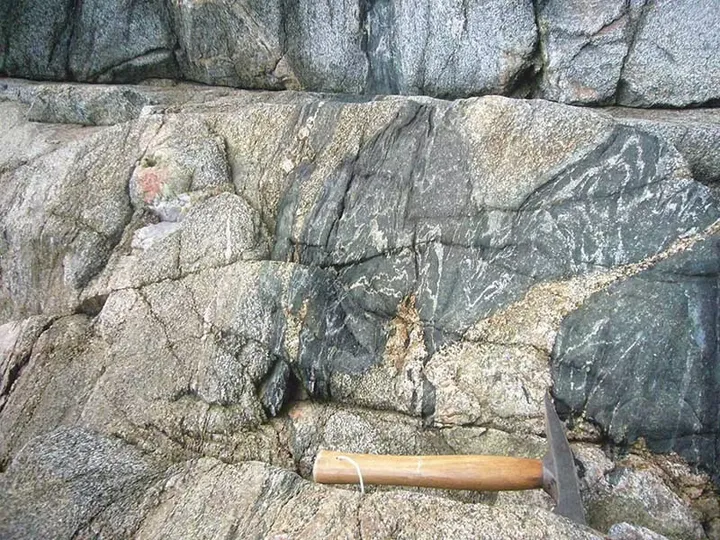
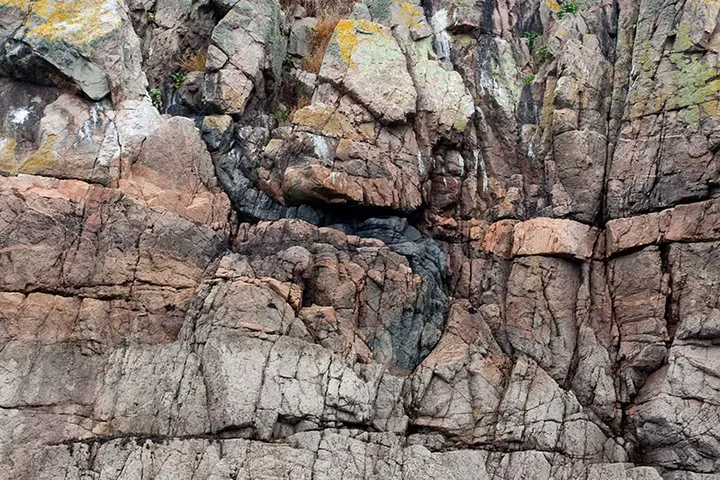
Biotite gneiss is the country rock of most of Sark, excluding Little Sark, and it is about 2 billion years old. It probably began as sedimentary mud mixed with lava, and after many episodes of folding, crushing and weathering its appearance varies across the island; a newly exposed surface is a glittery grey, often streaked with pale quartz and feldspar. Hornblende gneiss, similar in age, carries bands of pale granite and pale green epidote through its dark green or black body. Augen gneiss, an altered granite with large eye shaped feldspar crystals, is found on Sark only at Maseline Harbour and on Les Burons, though it is more common on Guernsey and Alderney.
The granite that is really diorite
Sark's granite carries an unusually high proportion of dark mica, making it darker than an ordinary granite; technically it is a diorite. It was intruded into the older gneiss about 680 million years ago, in the Pre-Cambrian, and it makes up all of Little Sark and the island's northern tip at L'Eperquerie. A separate sheet of granite runs through the island's central section, visible in the cliffs of the east and west beaches.
The dykes
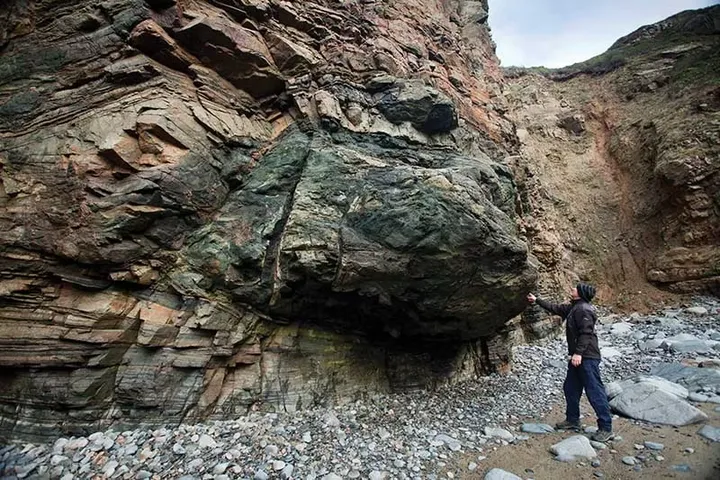
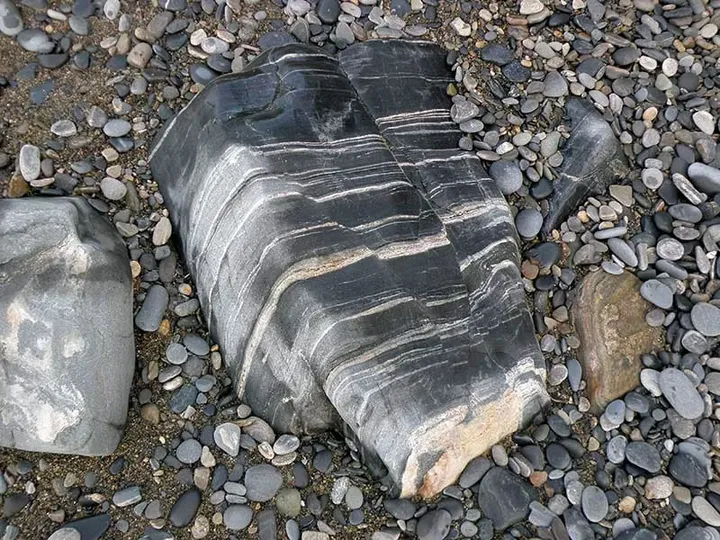
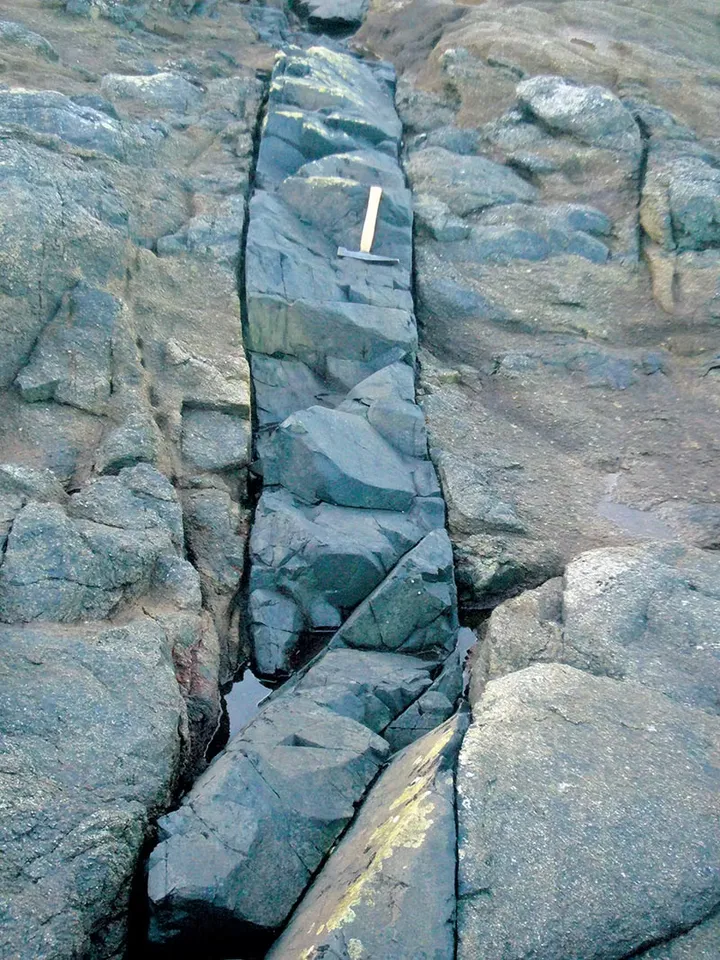
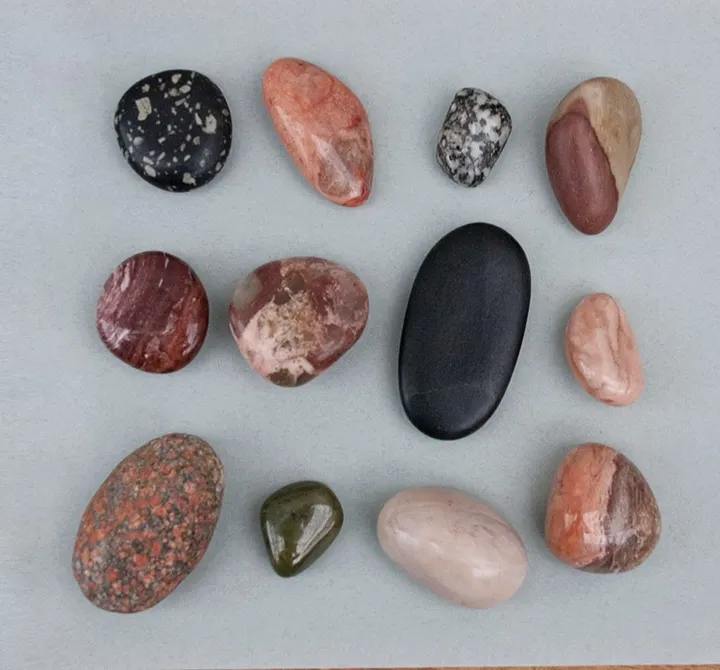
The island's rock is criss-crossed by intrusive dykes running roughly east to west, formed where cracks in cooled, brittle rock reached molten magma below. Three types occur on Sark. Dolerite is a smooth black or dark grey rock related to basalt and gabbro, and in its porphyritic form, with large feldspar crystals beautifully spread through the black ground, it is thought to have attracted the attention of Neolithic people. Felsite, a whitish rock of quartz and feldspar, tends to follow dolerite intrusions. Lamprophyre dykes are the rarest and the youngest rocks in the Channel Islands, intruded about 280 million years ago in the Permian; they come from deep below the Earth's crust, and their high carbon dioxide content is thought to have driven them upward rapidly.
This page follows Felicity Belfield's account of Sark's geology for La Société Sercquaise. Her illustrated guide, Sark Rocks, is available from La Société Sercquaise.
