All Journal stories Sark's Sea Caves and Hidden Coast
The Sark JournalAlan Turing on Sark: a holiday before the legend
Enjoying the Sark Journal? Get new Sark stories by email.
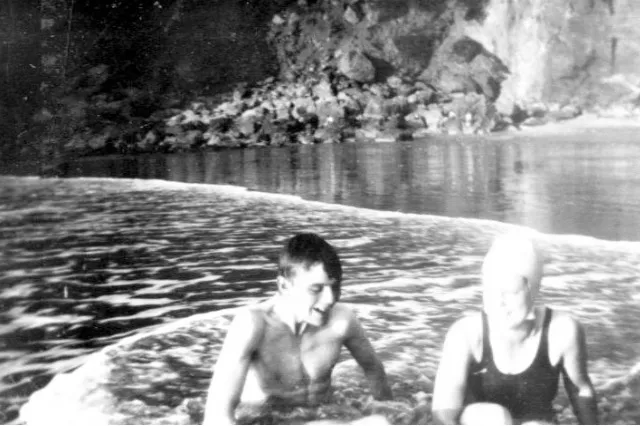
There is a photograph of Alan Turing on Sark in September 1932.
He is twenty years old. Beside him is Peggy Shaw. The photograph survives in the Sherborne School archive.
Turing had come up to King’s College, Cambridge, the previous October after winning an Open Scholarship in Mathematics. He would take a First in the Mathematical Tripos in 1934 and become a Fellow of King’s in 1935. John Maynard Keynes, then a King’s Fellow and a member of the committee electing new fellows, wrote privately in 1935 that Turing seemed “much the cleverest on paper” among the candidates and that there could not be “a shadow of doubt” about him.
He had remained in touch with Geoffrey O’Hanlon, his former housemaster at Westcott House, Sherborne. O’Hanlon took boys from the house on holidays to Sark and Cornwall, and Turing joined him on several of them.
Another Sherborne photograph places Turing on Sark a year earlier, in September 1931, with O’Hanlon and Peter Hogg. They were two separate holidays, a year apart.
Where they stayed, and where they swam
O’Hanlon’s photograph albums, still at Sherborne, cover his Sark holidays from 1927 to 1932, and Jane Norwich of La Société Sercquaise’s family history group has traced the two that Turing joined. The first came just before he went up to Cambridge in 1931; the second was the following September. O’Hanlon liked the island enough to come back with his new wife in 1934 and again in 1936.
The party stayed each time at La Ville, with the Baker family at La Moinerie. Mrs “LouLou” Baker was known for her hospitality and took in paying guests every summer until the outbreak of the Second World War. Her daughter Phyllis, born in 1924, would have been of an age to meet Turing; a third daughter, Isabel, was born in late September 1931, while the party was on the island.
The albums show the party doing what visitors still do: the usual sights, and bathing trips to the Adonis and Venus pools.
O’Hanlon remembered those holidays after Turing’s death in 1954. In an appreciation written for the Old Shirburnian Society, he is reported to have referred to “mixed bathing at midnight” in his account of the Cornwall and Sark holidays. The historian Jonathan Parry, in the London Review of Books, says the young Turing went skinny-dipping off Sark’s rocks.
In 1935 Turing attended Max Newman’s Cambridge lectures on the foundations of mathematics. Newman encouraged him to consider whether a mechanical process could determine whether a mathematical statement was provable.
In his 1936 paper, On Computable Numbers, with an Application to the Entscheidungsproblem, he described an abstract machine operating on symbols on a tape. A version capable of carrying out the work of any such machine became known as the universal Turing machine. King’s College describes the breakthrough as providing the core concept for the later development of computing.
He was twenty-three when the paper was completed.
Turing went to Princeton, completed a PhD and returned to King’s in 1938. When war began, he joined the Government Code and Cypher School at Bletchley Park and became part of the effort to decipher messages enciphered by German Enigma machines. He was awarded an OBE in 1946 for his wartime work.
After the war he worked on electronic computers, first at the National Physical Laboratory and then at Manchester. At the NPL his design for the Automatic Computing Engine was accepted in 1946. He moved to Manchester in 1948, where his work included programming, neural nets and artificial intelligence.
His 1950 paper Computing Machinery and Intelligence asked whether machines could think and proposed the “imitation game” that became known as the Turing test. Two years later he published a mathematical theory of morphogenesis, investigating how chemical processes could produce biological patterns during growth.
He was elected a Fellow of the Royal Society in 1951.
The King’s archive records a less formal Turing too. He rowed at Cambridge and later became a long-distance runner. It also holds an unfinished short story written by him; Cambridge researchers published a study of it in 2026.
Turing was prosecuted in 1952 after acknowledging a sexual relationship with another man. He pleaded guilty. He died in 1954, aged forty-one.
The Sark photographs come before that tragedy and before almost all of the work that made his name.
The island under occupation
While Turing was at Bletchley breaking the Kriegsmarine’s Enigma traffic, the Channel Islands were under German occupation. Norwich records that one of those Enigma machines was in use at the German radio transmitter station at Les Sapins, on the island where he had swum. Whether he ever thought of those September holidays as he worked, nobody recorded.
