
All Journal stories Sark's Sea Caves and Hidden Coast
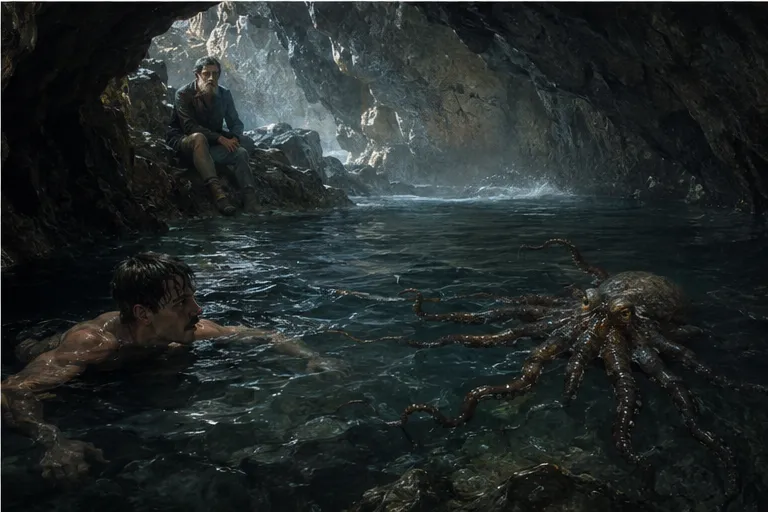
The Sark JournalVictor Hugo's son went swimming on Sark. An octopus followed him.
Enjoying the Sark Journal? Get new Sark stories by email.
Charles Hugo went swimming on Sark in June 1857.
An octopus followed him.
His father was watching.
Victor Hugo was living in exile in Guernsey when he visited Sark. During the visit Charles bathed in a cave. An octopus pursued him through the water.
Nine years later Hugo published Les Travailleurs de la Mer, The Toilers of the Sea.
The novel follows Gilliatt, a Guernsey fisherman who sets out to recover the engine of the wrecked steamship Durande. The task takes him into a Channel Islands world of reefs, tides, rocks and caves. Eventually he encounters the octopus.
The surviving evidence does not give us a note from Hugo saying that Charles’s swim became Gilliatt’s fight. Hugo saw the incident on Sark in 1857, and nine years later placed an octopus encounter inside a novel saturated with Channel Islands coast and sea.
There is a possible Sark trace in the novel. Hugo’s use of the French word pieuvre for octopus has been linked to Norman speech in the Channel Islands, including Sercquiais. The linguistic route is debated. It is better treated as an argument than as a solved etymology.
The cave itself should not be over-identified. Later Sark tradition associates a cave with Hugo, but the evidence reviewed for this article does not justify calling it the Boutiques or pinning the Charles incident to a more precise modern cave name.
The caves of Sark still make the connection easy to understand.
For a week with time for books as well as the island, see our Reading Retreat on Sark.
