
All Journal stories Things to Do on Sark
The Sark JournalLa Coupée
Enjoying the Sark Journal? Get new Sark stories by email.
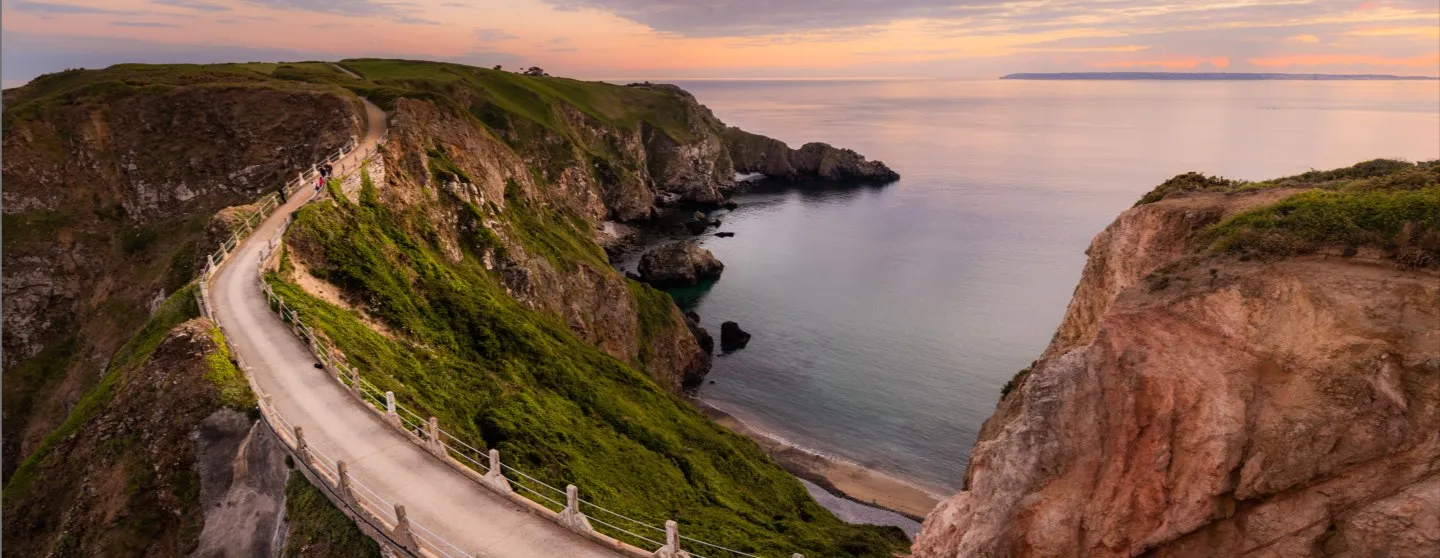
La Coupée is the piece of land that keeps Sark in two parts without allowing it to become two islands, not simply a narrow path with a dramatic view.
Great Sark lies to the north. Little Sark lies to the south. Between them, the plateau narrows to a single exposed ridge with the sea falling away on both sides.
Reaching Little Sark means crossing this ridge first, on foot, by bicycle, or by carriage.
Why is La Coupée so special?
La Coupée is the only land route between Sark and Little Sark.
People, bicycles, horses, supplies and emergency services all have to cross it. That turns a single narrow crossing into essential infrastructure.
A crossing that changes your pace
The concrete roadway across La Coupée is unlike the lanes, tracks and paths elsewhere on Sark.
Bicycles are walked across it. Horse-drawn carriages cross without their passengers: everyone gets out and walks while the carriage crosses alone.
That change of pace is part of the experience.
You become aware of the height, the wind and the sea on both sides. Partway across, the ground falls away to Grande Grève on the west. Little else on Sark asks for this much attention in so short a distance.
The crossing underfoot today
The occupation did not leave the roadway behind. The British Army built it, using POW labour.
Following Sark’s liberation in May 1945, German prisoners of war worked under Royal Engineers supervision on La Coupée. They laid the concrete roadway and added protective handrails, finishing that November. They also regraded the approaches on both cliffs, lowering them so the descent onto the ridge was less steep, and deliberately left the surface bare through the middle of each slope so a horse’s shod hooves could still find grip under a heavy load. A small plaque set into the concrete on the Little Sark side still records their work, and before they left, they made a toy for every child on the island in time for Christmas.
You are walking on that same roadway every time you cross.
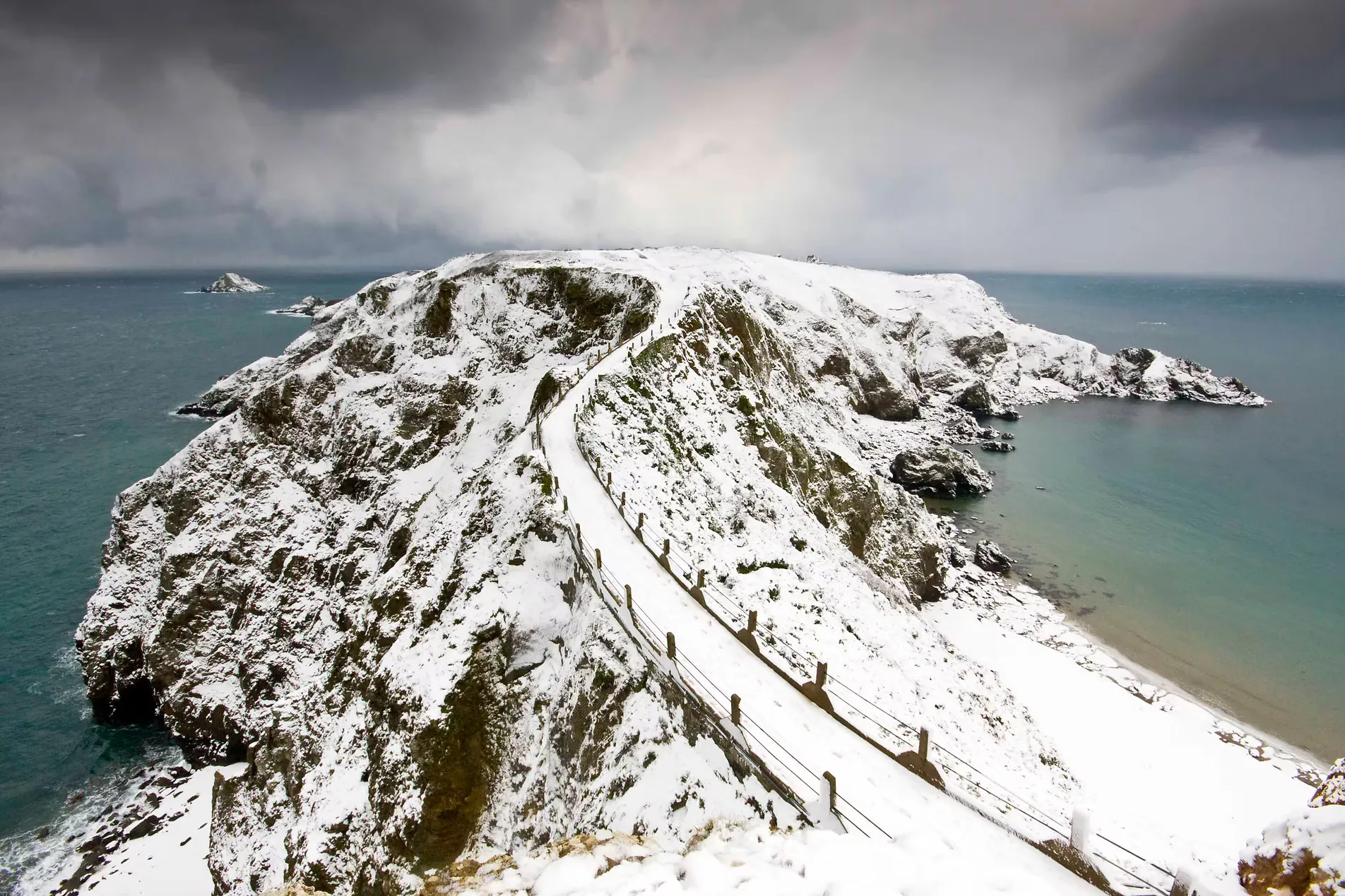
La Coupée, in snow.
Before the protected crossing
La Coupée is what erosion has left of the ridge joining Great Sark and Little Sark, worn narrower by the sea on both sides, not a built causeway.
Little Sark, on the far side of the crossing, is diorite, a dark, mica-rich granite intruded into Sark’s older gneiss around 680 million years ago. That is younger rock than most of Great Sark, whose grey, glittery gneiss dates back some two billion years, but it is hard enough to stand as a cliff rather than crumble as a slope, which is part of why the ground either side of La Coupée survives as a narrow ridge instead of eroding away completely. The narrowing came not from steady wear so much as a sequence of landslides and rock falls hitting the same exposed ridge.
By 1811 that erosion had reduced the roadway to less than a stride wide. Responsibility for keeping it passable was disputed for years between the islanders and the Seigneur, until an 1812 agreement settled that inhabitants would give two days’ labour on the road each year while the Seigneur funded the rest. A retaining wall went up on the west side after a further landslip in 1862, and the first protecting rail followed in 1900, nearly a century after the earliest record of the crossing narrowing.
Erosion has not stopped since. In December 2009, a landslip covered part of the path down to Grande Grève on the west side and closed it for a time. The descent now in use is a steeper path cut by volunteers, used at your own risk. Repairs continue to be carried out on the east side of La Coupée too, a maintained structure rather than a finished one.
Long before 1945
The crossing needed this kind of care long before written accounts described the ridge narrowing.
Chief Pleas court records from the 1620s fined a Sark tenant, Philippe Guille, for taking earth from the road near La Coupée to build up a boundary bank between his land and his neighbour Jean Noel’s, treating the path as shared infrastructure worth a court’s attention centuries before any retaining wall or rail existed. Records from the same period describe a Sark man, François Vibert, leading his own horse across on foot rather than riding it, and vraic cutters working the low tide rocks directly beneath the ridge each March, cutting kelp for fertiliser.
The stories people told about La Coupée
La Coupée was not always safe to cross.
An 1875 description of the island records visitors who threw themselves flat on the path from terror partway across, or hid behind an outcrop of rock until someone came to lead them over. Some could only cross with their eyes shut, led between two other people, and people crossed on hands and knees in high wind.
In 1731, Philippe Hamon was blown off La Coupée to his death while carrying a corn tithe to Dame Le Pelley, more than a century before the first protecting rail was installed. Elie Guille, of the Clos-à-Jaon, died the same way on 4 September 1802, carrying sheaves of corn across for the same kind of payment. Two known deaths, over seventy years apart, on the same exposed stride of rock, and it is easy to see why people came to believe the crossing was haunted.
Sark folklore places the Tchico at La Coupée, a monstrous black hound said to pursue those about to die. Other versions attach a headless horseman or a floating coffin to the crossing.
A vicar, James Cachemaille, recorded a fisherman terrorised by an unearthly howl while crossing at night, a sound Cachemaille believed came from a cave below. Sybil Hathaway said her childhood donkey refused to cross the ridge even blindfolded, and many took that as a sign the animal could sense the Tchico.
The same walk, a little further on
The walk that takes in La Coupée does not stop there. Continuing north brings you to the Pilcher Monument, a stone obelisk marking a shipwreck on 19 October 1868 in which everyone aboard died. On a clear day, it is one of the few points in the Channel Islands from which every other island can be seen at once.
Our walking Sark article covers the whole route.
What changes on the other side
Little Sark is quieter again, and different enough to deserve its own telling. Our Little Sark article covers the silver mine, the closed Michelin-starred restaurant, and the pools cut into the rock.
Writers, and the sea still at work
La Coupée has a literary record. John Oxenham’s 1910 novel A Maid of the Silver Sea is set around Little Sark’s mines and this crossing, and Mervyn Peake’s Gormenghast novels are said to draw on the island’s landscape; the Countess in Gormenghast asks of Little Sark, “Did you not have to crawl across the Coupee, the high knife-edge? How else could you have returned?”
The sea is not finished with it either. The land on both sides of La Coupée has been eroded, the isthmus is gradually narrowing, and a similar process is thought to have already separated Brecqhou from Sark.
Four centuries of caution on La Coupée
La Coupée is a geological feature, a granite ridge onto Little Sark’s diorite that the sea has narrowed for as long as anyone has kept a record. It is also infrastructure, the only land route between two halves of one small island, maintained, disputed over and repaired for four centuries because there has never been an alternative. And underneath both of those sits a real death and the ghost stories that grew out of an ordinary, working fear of a real drop.
Islanders led their own horses across the ridge on foot in the 1620s. Close to four hundred years later, Sark’s carriages still cross with the horse walking and the passengers already on the ground beside it. The crossing itself has changed, from a bare stride wide ridge to a protected concrete road. The caution it earns has not.
Our cycling article explains why bicycles are walked across La Coupée. The Second World War article covers the occupation and liberation in more depth, while Sark folklore explores the stories attached to the island’s real places.
