
All Journal stories Norman Sark
The Sark JournalThe Women of Sark's 1565 Settlement
Enjoying the Sark Journal? Get new Sark stories by email.
The familiar story is forty men and forty muskets: the tenant-holders of Sark’s new tenements, each tied to the defence of the island.
It is easy to hear that phrase and picture forty men, with forty families, arriving together. That is not what happened. A small party came first in 1565. Other households followed. Some settlers stayed for a time and sold their land back to the Seigneur. Some landholders were absent from Sark and rented their holdings to others. By 1579, the island’s population was already more than 200.
The settlement was a process, not a single landing.
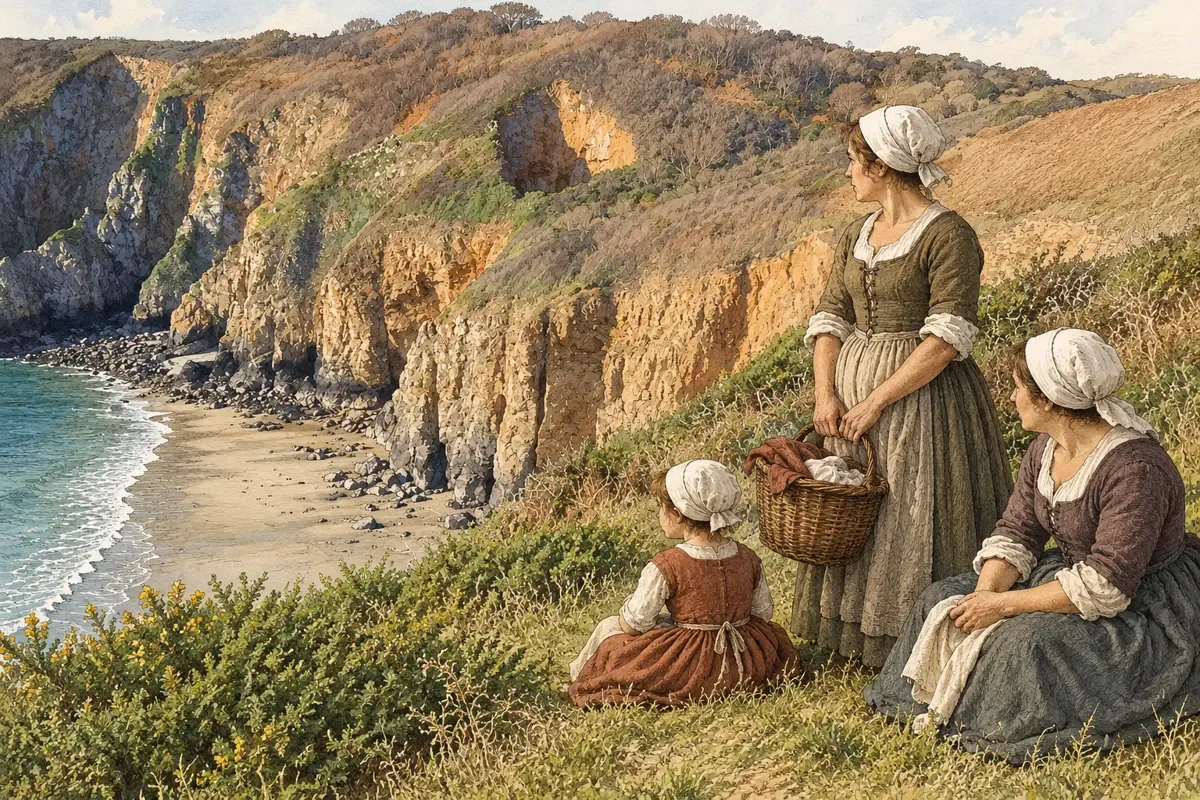
And behind the names of the male tenants were women, children, widows, daughters, servants and other people whose lives are much harder to recover from the surviving record.
The records do give us glimpses. Margaret de Carteret accompanied the first settlement party. Remy du Puits arrived with professional skills that mattered to a new community. Peronelle Lemprière appears in the history of Beauregard. A widow at Clos de la Ville was left with eight children. Judith Quesle inherited La Ville Farm.
Taken together, those fragments give a different view of the settlement.
Margaret de Carteret comes to Sark
Ewen and de Carteret place Margaret de Carteret beside her husband Helier in the small pilot settlement party of 1565. They describe this first group as drawn largely from his family and tenants in St Ouen, Jersey.
The later recruitment of settlers brought more households to the island. The holdings were intended to support families, with a house maintained on each and an armed man available for defence.
But the armed man named in the land records was only one member of a household. Establishing a home meant building and maintaining a small house, cultivating and harvesting land, caring for stock, carrying out domestic work and raising children. Life was hard for everyone involved in making the settlement viable.
The account names Margaret among the settlers but gives no description of her daily work. Her presence is recorded; her own account of the move is not.
Remy du Puits brings a profession
Remy du Puits was a Parisian midwife. Her husband, Jean Quesle, was a surgeon from Meaux. They had two sons and two daughters.
They were also Huguenot refugees, part of the movement of French Protestants displaced by religious persecution in the sixteenth century. Ewen and de Carteret place the family among refugees known to Nicolas Gosselin, the uncle of the Beauregard tenant of the same name, during his time in Geneva. They subsequently came to Jersey.
The offer of La Ville Farm persuaded Quesle to move with his family to Sark. The book specifically identifies the professional skills of both parents as valuable to the new community.
That makes the Quesles particularly revealing. Sark was not simply recruiting forty men capable of bearing muskets. The new community needed people who could keep others alive. A surgeon and a midwife brought knowledge that mattered just as much to the survival of a small and isolated population.
Remy’s profession is recorded, although the account supplies no details of the births she attended.
Peronelle Lemprière
Peronelle Lemprière was a Jersey woman married to Nicolas Gosselin, the holder of Beauregard.
Ewen and de Carteret note, almost in passing, that she could read and write. On its own, that is not much of a story. Set beside the Quesles’ medical skills and the wider movement of families into Sark, it adds to the picture of a settlement made up of people with different backgrounds and abilities, not simply a list of armed male tenants.
The history of Beauregard describes the grant of land and the requirement to supply four men for defence. Peronelle appears only briefly within that account, but her name survives.
1579: a widow and eight children at Clos de la Ville
Philippe Alexandre died in 1579, leaving a widow and eight children. His widow struggled to meet the obligations attached to Clos de la Ville.
Ewen and de Carteret suggest that Gervais Mahier, of the neighbouring tenement Le Carrefour, worked the land. They do not name the widow in this account.
It is one of the starkest fragments in the record. Fourteen years after the first settlement party arrived, a woman was trying to maintain a household of nine while the obligations of the tenement continued.
The record preserves the number of children and the difficulty of meeting the property’s obligations, but not their mother’s name.
1580: Judith Quesle inherits La Ville Farm
Both of Jean Quesle’s sons died before him. When he died in 1580, La Ville Farm passed to his elder daughter, Judith, who was married to Jean de Carteret.
Within fifteen years of the settlement, one of its original holdings had passed to a daughter. The history of La Ville Farm follows Judith into the succession of the property.
Remy and Judith appear in different parts of that history: the mother through her professional skill, the daughter through the inheritance of the family’s land.
The names beyond the forty
The table of tenants records who held the land. It cannot serve as a complete census of the people who established Sark’s new community.
Nor should the forty tenements be mistaken for forty permanent households arriving all at once. Some holders left. Some sold land back to the Seigneur. Some were absentee landholders whose property was worked by others. Meanwhile the population grew rapidly. By 1579, it had passed 200.
That matters when we try to imagine the island. The legal structure was built around forty holdings and their defence obligations. The human settlement was larger, more fluid and more complicated.
The women emerge unevenly from the surviving accounts. Sometimes we have a name and a profession. Sometimes a marriage or an inheritance. Sometimes, as at Clos de la Ville, we know only that a widow had eight children and was struggling to keep the holding going.
But even these fragments change the picture.
Behind Sark’s forty muskets were a Parisian midwife, a surgeon from Meaux, Huguenot families travelling through Geneva and Jersey, a Jersey woman at Beauregard, a daughter inheriting La Ville Farm and an unnamed widow raising eight children while trying to keep a tenement going.
For the defence obligations and the later divisions of the land, read 40 Men and 40 Muskets.
Records of the women
A. H. Ewen and Allan R. de Carteret, The Fief of Sark (1969): pp. 35 and 42 for households and defence obligations; pp. 38-39 for Margaret and the initial party; p. 37 for Peronelle Lemprière; pp. 41-42 for Remy du Puits and the Quesle family; p. 126 for Philippe Alexandre’s widow and Judith Quesle’s inheritance. Page references are printed page numbers, not viewer sheets.
The book’s account supplies the specific biographical details above. No personal testimony, daily routine or individual delivery by Remy is asserted. The widow’s name is absent from the passage examined, not declared absent from every surviving record.
