
All Journal stories The German Occupation of Sark
The Sark JournalOperation Basalt
Enjoying the Sark Journal? Get new Sark stories by email.
Twelve commandos climbed the Hogsback in the moonlight on the night of 3 October 1942, making for the German billet at Dixcart.
They were not Special Air Service. Sark’s own record names the unit as the Small Scale Raiding Force, a distinct commando formation, and no source in that record connects this raid to the SAS. The two threads are easy to confuse, both wartime irregular units, both raiding behind enemy lines within a few years of each other, and worth keeping separate here.
The raid lasted a few hours. Its consequences reached the whole island, and changed what the German occupiers considered a captured commando was owed.
This was not the first attempt. Two weeks earlier, on the night of 18 to 19 September, the same plan was tried and abandoned. MTB 344 left Portland at ten that evening, but strong currents delayed its arrival off Sark until three in the morning, too late to land and still clear German-held waters before the boat’s own half past three deadline. Nobody went ashore that night, and the boat returned safely to Portland.
Landing on the Hogsback
The raiding party, led by Major Geoffrey Appleyard, came ashore from Motor Torpedo Boat 344 at Point Château, at the foot of the Hogsback, at half past eleven that night. Lieutenant Freddie Bourne commanded the boat.
Approaching from the south, the vessel was picked out and challenged by searchlight from La Coupée. The crew answered that they were a German boat with engine trouble, asking permission to put in for repairs. It was granted.
The twelve men climbed the Hogsback and made first for Le Petit Dixcart, which they found empty. They crossed the valley to La Jaspellerie and went in through the French windows, expecting to find German soldiers billeted there. Instead they found the house’s occupant, a recently widowed woman named Frances Pittard, upstairs in bed.
Mrs Pittard told the commandos where the German garrison was in fact billeted, at the Dixcart Hotel annex, and gave them a copy of the Guernsey Evening Press carrying news of Sark’s recent deportations. She turned down the offer of passage back to England. She was later arrested and held for a time in Guernsey prison before being allowed to return to Sark.
What the raiders knew going in
The raiders had little to go on. Major Appleyard’s own family had holidayed on Sark before the war, and the group trained partly from those family home movies and a civilian hiking guide to the island, since almost no other detailed information existed. Aerial reconnaissance beforehand mistook a nineteenth century cannon for a machine gun nest.
More than 300 German soldiers were stationed on Sark that autumn, including a group at the nearby Stocks Hotel, less than a hundred metres from the Dixcart Hotel annex the raiders searched.
The raid at Dixcart
The party moved on to the hotel. Around two in the morning, the sentry on duty, Obergefreiter Peter Oswald, was stabbed by Lieutenant Anders Lassen, a Dane serving with the raiders who later became the only non-Commonwealth soldier ever awarded the Victoria Cross.
The commandos went in. The German soldiers inside realised how few raiders there were and began to shout, raising the alarm. In the confusion that followed, one prisoner, Gefreiter Klotz, escaped naked and a second went with him. Two more, Heinrich Esslinger and Gefreiter August Bleyer, were shot dead trying to escape. A fifth, Obergefreiter Weinreich, commander of the small group of engineers, was taken prisoner and marched back to the boat. He was later interrogated at the London Cage, where he gave useful intelligence on German defences on Sark and the French coast.
A German report from General Muller, sent to Divisional headquarters on 6 October 1942, described the encounter differently again, as pioneer troops overpowered and led away, with an escape attempt only at the quarters. The two accounts do not fully agree on what happened in the dark at Dixcart that night. What both agree on is the outcome: two German dead, and one German prisoner taken back to Britain.
Lieutenant Bourne had waited far longer than planned in the boat below, close to two hours past the scheduled return, before the raiding party reached him.
The Commando Order
The Germans reported that the escaping prisoners had been shot with their hands bound. Hitler used that report to order, on 9 October, that 1,376 Allied prisoners taken at Dieppe be shackled.
Churchill answered that an equal number of German prisoners held in Canada would be shackled in response. The Germans said they would treble that number against British prisoners if it came to it. Canada shackled its German prisoners at a camp in Bowmanville, Ontario, and met fierce resistance. The Swiss government stepped in to mediate.
On 18 October 1942, Hitler issued the order that followed directly from the raid: the Kommandobefehl, or Commando Order. It directed that captured Allied commandos be treated, in its own words, as troops and agents “who do not act as soldiers but like bandits”, to be dealt with accordingly and without trial, whether or not they had been captured in uniform.
The order applied everywhere the Germans were fighting, not only in the Channel Islands. It followed Operation Basalt by about two weeks, not the three days sometimes claimed.
What the raid cost Sark
The relationship between the Germans and the Sarkese cooled considerably after the raid. The curfew was extended, from nine at night to seven in the morning.
More than 13,000 mines were laid across Sark’s cliff paths and headlands, on the beaches, and even in the cemetery. Rabbits could no longer be hunted. Gorse and blackthorn, gathered for fuel, could no longer be safely collected in many places. Limpets and ormers on the shoreline, and vraic, the seaweed islanders had always cut to fertilise their fields, became dangerous or impossible to reach.
On 23 October 1942, the Sark fishing boats were ordered brought up from the harbour altogether.
The wider occupation, and how these restrictions fit into five years of German rule on Sark, is covered in Sark in the Second World War.
What’s left to see
A small oak tree stands near the Hogsback and Derrible route today, planted in 2009 and brought from Normandy, commemorating Major Geoffrey Appleyard, who led the raid. A further memorial was unveiled on the cliff top on Sark in October 2022, on the raid’s 80th anniversary.
The mines themselves are long cleared. Most were lifted by German soldiers in the days after liberation in May 1945, at a cost of two more lives among the men doing the clearing. The route the raiders climbed that night, up from Point Château along the Hogsback, was used again a year later, on the night of 26 to 27 December 1943, for the war’s final Commando raid on the Channel Islands, Operation Hardtack 7. Mines laid in Basalt’s aftermath killed two of the raiders that time, Corporal Robert Bellamy and Corporal André Dignac.
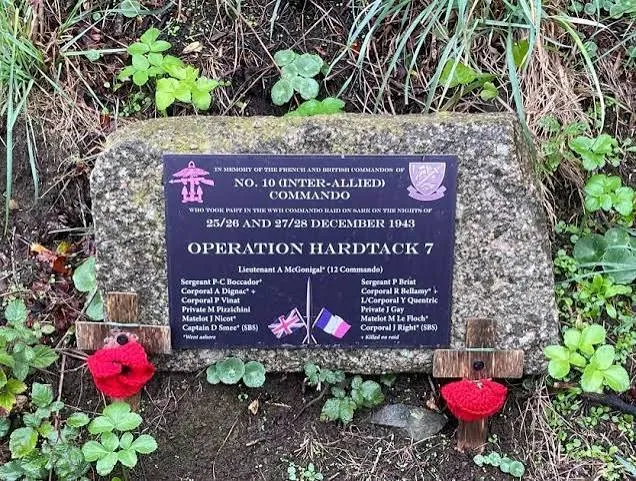
The Operation Hardtack 7 memorial stone on Sark, naming Corporal Robert Bellamy and Corporal André Dignac among the dead.
Walking the Hogsback now, there is little to mark what happened there in October 1942 beyond that one young oak tree. The path is the same path. For more than two and a half years afterward, walking it meant crossing ground seeded with mines. None of that danger is visible today.
