
All Journal stories The German Occupation of Sark
The Sark JournalSark in the Second World War
Enjoying the Sark Journal? Get new Sark stories by email.
The occupation of Sark did not happen beyond the island’s ordinary life; it happened inside it.
German soldiers slept in its hotels. Ammunition was stored in a village building. The windmill became a lookout. Fishing, farming and movement along the coast were restricted. People negotiated, adapted, went hungry and waited for a liberation that reached Sark a day later than Guernsey.
Because the island is small, much of that WW2 history remains close together.
The Germans arrive
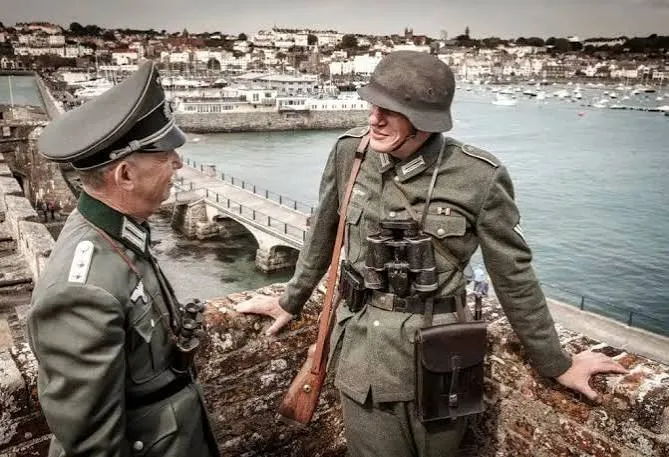
German officers reached Sark on 3 July.
Most residents had remained on the island. Dame Sibyl Hathaway had advised them to stay, believing Sark could continue to feed itself through farming and fishing.
When the first officers arrived, she received them at La Seigneurie. She spoke German and understood that Sark’s survival would depend partly on how its unusual constitution and small civilian population were presented to the occupying authorities.
That did not give her control over the occupation, but it did give her a position from which to argue for the island and its residents.
The relationship mattered because there was nowhere for either side to disappear. The occupying force and the people living under it shared the same few lanes, shops, fields and buildings.
War enters ordinary places
The soldiers were first billeted at the Bel Air Hotel. Rose Cottage on Rosebud Hill became the German headquarters. The Gallery, now part of the village’s everyday life, was used to store ammunition.
At first, farming and fishing continued. Supplies still arrived. There were even football matches and social events involving islanders and German soldiers.
Then restrictions tightened.
Fishing hours were limited. Food and fuel became scarce. Islanders made tea from blackberry and rose leaves, stretched clothing and household materials far beyond their intended use, and relied increasingly on what could be grown or gathered locally. The fuller story of those substitutions is in When the tea ran out.
This is one reason Sark’s wartime history is so revealing. The island had no large industrial system to fall back on. Survival depended on soil, boats, animals, stored food and cooperation between neighbours.
Operation Basalt
On the night of 3 to 4 October 1942, twelve British commandos landed on Sark during Operation Basalt.
Their objective was to capture a German prisoner and gather information. The raid reached the German billet in the Dixcart area. During the withdrawal, German soldiers died and one prisoner was taken back to Britain.
The consequences extended far beyond the raid itself.
Hitler issued the Commando Order on 18 October 1942. It directed that captured commandos should be executed rather than treated as prisoners of war.
On Sark, security tightened. Mines were laid across cliffs, headlands and beaches. Coastal activities that had supported island life, including gathering vraic and shellfish, became dangerous or impossible in many places.
A raid lasting one night changed how the island could use its own coastline.
The full account, the landing, the searchlight ruse, and what happened at Dixcart, is in Operation Basalt.
The landscape becomes military ground
Sark’s cliffs and narrow approaches had always limited how people could move, farm and fish. Under occupation, they were militarised.
The windmill was taken over as a lookout in 1940 and fortified further in 1942. Observation openings were cut into the tower, the surrounding ground was mined and the remaining windmill structure was dismantled for military use.
The same height that had once allowed the mill to catch the wind now allowed soldiers to watch the sea.
That change captures the occupation at island scale. Places built for food, farming and movement were turned toward surveillance and defence.
Deportation and hunger
Residents were deported from Sark in 1942 and 1943. Families were separated and people were sent through camps in occupied Europe and Germany.
Those who remained faced worsening shortages.
By the final winter, both islanders and German soldiers were hungry. The Swedish Red Cross ship SS Vega brought relief supplies to the Channel Islands from December 1944. Sark’s share was collected by boat from Guernsey.
The parcels helped carry the islands through the final months of the war.
Liberation
Guernsey was liberated on 9 May 1945. Sark’s formal surrender followed on 10 May.
Dame Sibyl interpreted during the surrender. For several more days, she was left managing the island while German soldiers remained there awaiting removal.
The occupation had lasted almost five years.
Its physical aftermath is still part of Sark. Our Sark WW2 memorial walk follows the sites you can visit today.
German prisoners of war, supervised by Royal Engineers, later resurfaced La Coupée and added protective handrails. The concrete crossing used today emerged from the work that followed liberation.
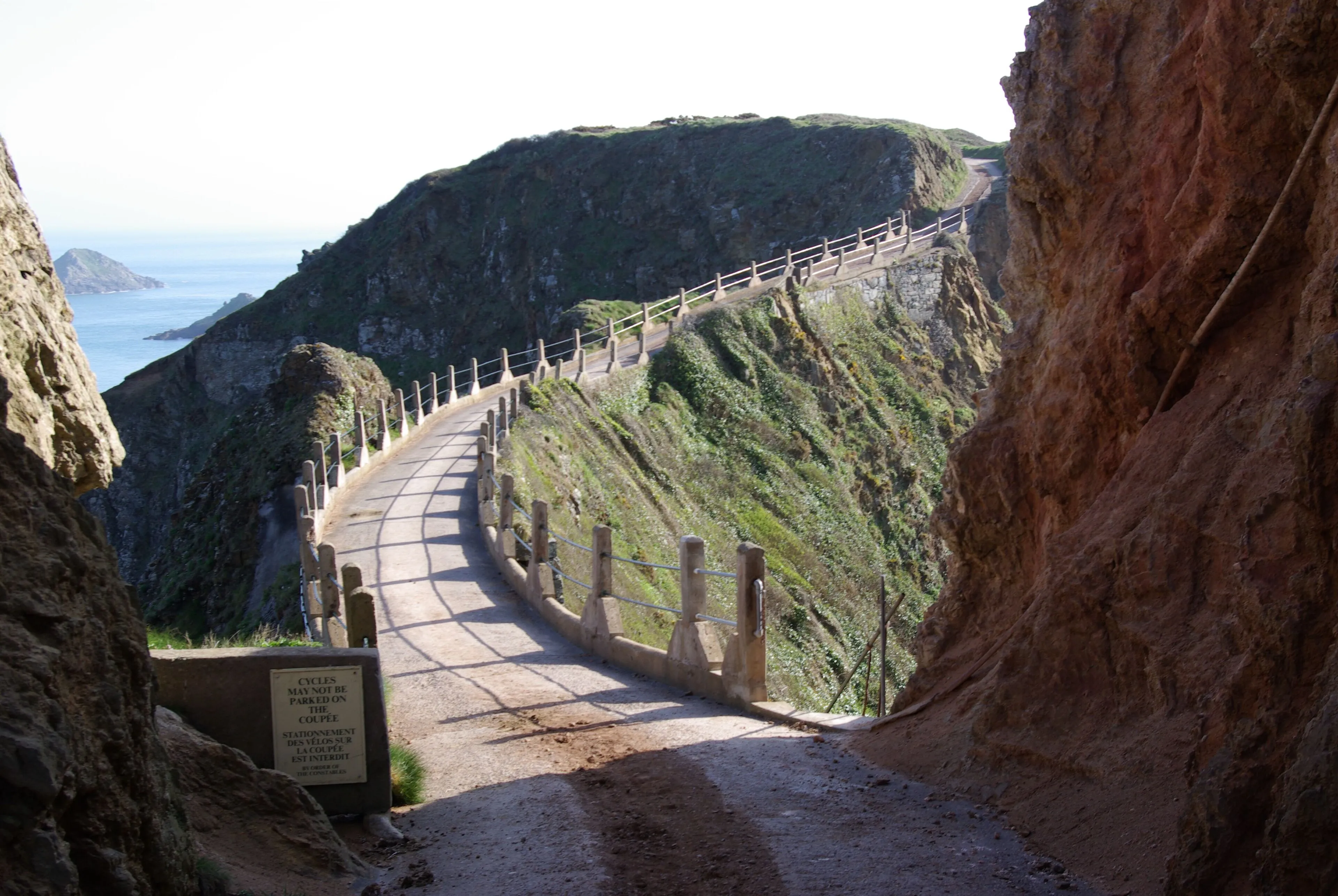
The concrete roadway across La Coupée was laid in 1945 by prisoners of war. Photograph by Clemensfranz, licensed CC BY-SA 3.0.
The windmill still bears the changes made during the occupation. The harbour, La Seigneurie, Rosebud Hill and Dixcart remain ordinary island places.
The wartime history of Sark’s quiet lanes
It is easy to describe Sark as peaceful because it has no cars, no street lighting and very little of the noise associated with modern life.
The wartime history gives that peace more weight.
The quiet was not preserved because the island escaped history. Sark was occupied, mined, restricted, depleted and divided from people who had been deported.
What survived here was a community and a landscape that had been used for war and then returned to ordinary life, not innocence.
Knowing that changes the island as you walk it.
A lane is still a lane. A field is still a field. La Coupée is still the way to Little Sark.
But the apparent simplicity of those places looks earned now, not empty.
Our very short history of Sark explains the longer history of the island. The Sark windmill carries one part of the occupation in its stonework. The Getting to Sark guide covers the journey.
