
All Journal stories Pirates, Smugglers and Shipwrecks
The Sark JournalSark's Coffin Legend
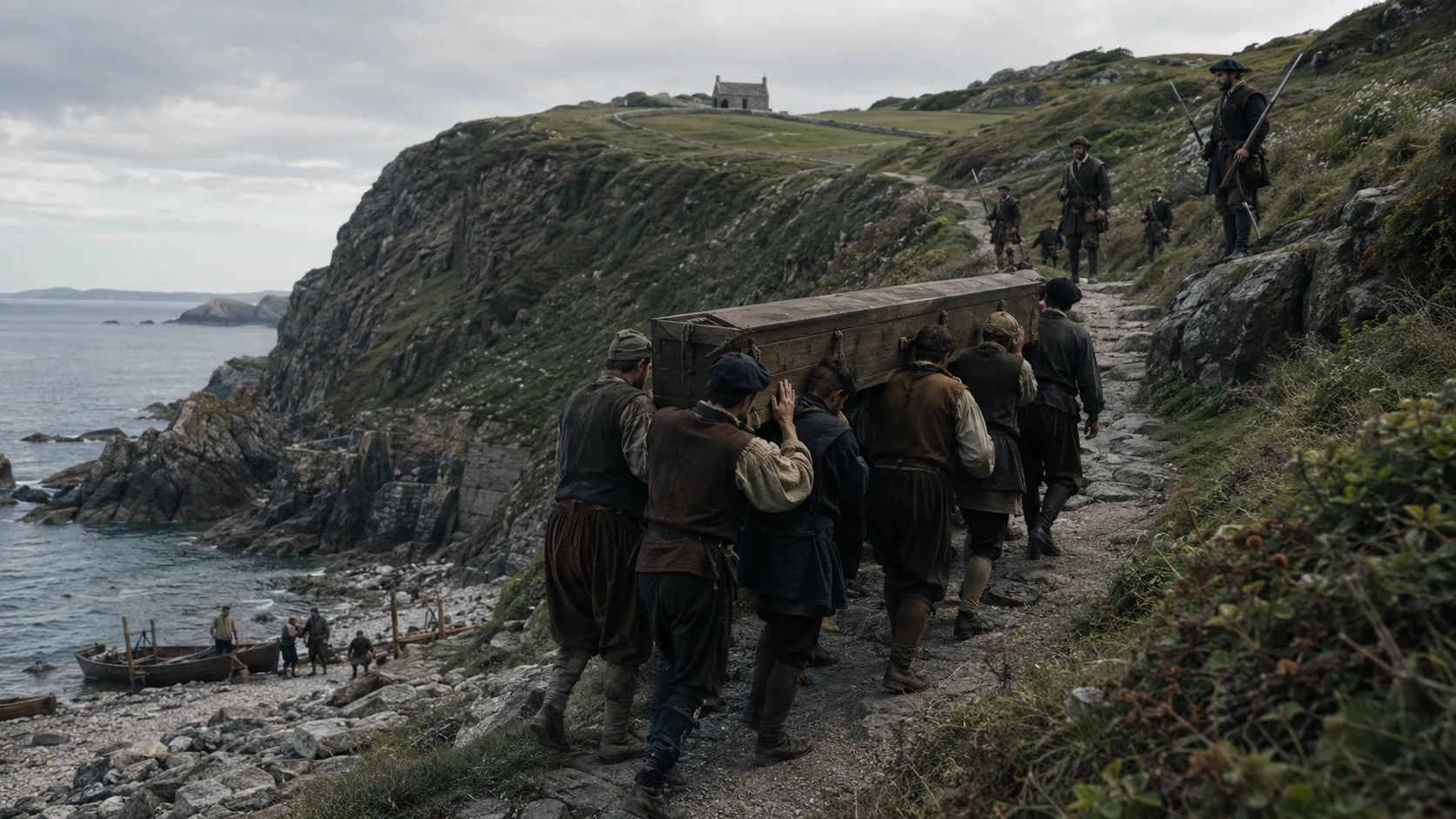
A burial party came ashore unarmed. The coffin they carried into the chapel contained no corpse.
Enjoying the Sark Journal? Get new Sark stories by email.
The men approaching Sark said that someone aboard their ship had died.
They wanted to bury him in consecrated ground.
The soldiers on the island agreed, but only after searching the burial party and making sure that none of the men carried a weapon.
Then the coffin was hauled up Sark’s cliffs.
Inside it was no corpse.
It contained swords, shields and firearms.
The story has survived for centuries because it turns Sark’s greatest defensive advantage against the people holding it. The cliffs make the island difficult to attack, so the attackers persuade the defenders to carry the means of their own defeat through the perimeter.
Sir Walter Raleigh recorded the episode in The History of the World. A bloodier version of the story later took hold on Sark.
The difference between the two is the most interesting part of the story.
Raleigh’s version
Raleigh places the event during the reign of Mary I, after French forces had taken Sark.
He describes the island as so inaccessible that it could not easily be recovered by force. A gentleman from the Netherlands therefore tried deception instead.
He anchored offshore and told the French garrison that his merchant had died. He asked for permission to bury the body in Sark’s chapel and offered the soldiers goods from the ship.
The French agreed, provided the men came ashore without weapons.
They searched them carefully.
The coffin was allowed through.
Once the burial party reached the chapel, the men shut the door, opened the coffin and armed themselves with the swords, shields and firearms hidden inside.
At the same time, some of the French soldiers had gone aboard the visitors’ ship to collect the promised goods. They were seized there.
The remaining French garrison found itself trapped between armed men on Sark and its own captured companions offshore.
They surrendered.
Nobody in Raleigh’s account needs to be massacred for the trick to work.
Sark’s version
The version preserved by Sark Tourism is different.
The French soldiers have become pirates. The attackers are merchants who are tired of being robbed. The weapons hidden inside the coffin are swords and longbows.
After reaching St Magloire’s chapel, the merchants arm themselves and attack.
Later Sark tradition adds one of the details that makes a story almost impossible to forget: an elderly woman is said to have escaped while baking bread, carrying a half cooked loaf as she fled towards La Coupee and hid in the cliffs until she was rescued.
Sark Tourism presents the episode as a legend, which is the right distinction.
Raleigh gives us an early written version of a military deception. The later island account gives us the story as generations of people on Sark preferred to tell it.
The two should not be silently merged.
Why the story grew
The coffin works in every version because Sark really was difficult to take by direct force.
A small number of defenders on high ground could make a landing dangerous. Anyone approaching by boat had to come through a limited number of places where people above could see them coming.
The attackers therefore needed permission to climb.
A burial created that permission.
Once the coffin reached the chapel, the geography that had protected the defenders began protecting the attackers instead.
That is the historical argument beneath the legend.
Sark’s isolation was never simply a picturesque quality. It made the island strategically valuable, and it made control of the landing places unusually important.
The same problem appears elsewhere in Sark’s history. Pirates used the island. French forces occupied it. Later, permanent settlement and defence became central to the way Sark was organised.
The coffin story compresses that long problem into a single object.
What we can say, and what we cannot
We can say that Raleigh recorded a coffin deception used to recover Sark from a French garrison.
We can say that Sark developed a later pirate version of the story.
We cannot currently prove that every detail in the later version happened, including the massacre or the woman surviving with the unfinished loaf.
That uncertainty is worth keeping.
Folklore is evidence of what people chose to repeat, not failed history.
What survived here is the coffin, the cliffs, and the idea that the island could only be taken by somebody clever enough to get past the geography.
What changed over time was everything around them.
For the earlier pirate story, read about Eustace the Monk and his Sark base. For the next documented encounter, read about the pirates who stole cattle, silver and beer.
