
All Journal stories Witchcraft, Magic and Mystery
The Sark JournalSark folklore, and the stories tied to the land
Enjoying the Sark Journal? Get new Sark stories by email.
Sark’s folklore is attached to places you can still walk past: a black hound at La Coupée, pixie-like creatures beneath standing stones and inside caves, witches on chimney ledges, and a ghost at La Seigneurie linked to a real drowning off the northern coast.
How the stories survived
Sark tradition includes evening gatherings called Les Veilles.
Islanders met in cottages, knitted and told stories around the joncquière, the “green bed,” a straw-covered bench made from a firewood box. Ghosts, pirates, witchcraft and old songs passed from one person to another before much of the material was written down.
That matters because folklore is not simply a list of strange beliefs.
It is a record of what people talked about when the day’s work was done. The stories reveal where danger was felt, which places carried memory and how a small community entertained itself through long evenings.
St Magloire and the vanished monastery
Sark’s oldest story belongs to St Magloire, a Welsh missionary said to be a cousin of King Arthur. In 565 he resigned as Archbishop of Dol to found a monastery on Sark with sixty two monks. He died on the island in 617, aged eighty two.
One story tells how his student monks borrowed an old boat to play on the beach after their lessons and were swept out to sea by a sudden storm. Magloire is said to have walked out across the waves to reach them, hooked the boat’s prow with his crook, and towed it to safety before vanishing again.
Nothing remains of the monastery itself. It stood near the site of the island’s prison, and its stones were used to build the houses of the Elizabethan colonists who resettled Sark a thousand years after Magloire arrived. But the place names survived: La Moinerie, the monastery; L’Ecluse, the milldam; and Port du Moulin, the bay below the monks’ watermill, all still on the map today. A pile of stones in the gardens of La Seigneurie was long believed to be a remnant of the monastery, and for years nobody moved it, for fear of disturbing the monk’s spirit.
The Tchico of La Coupée
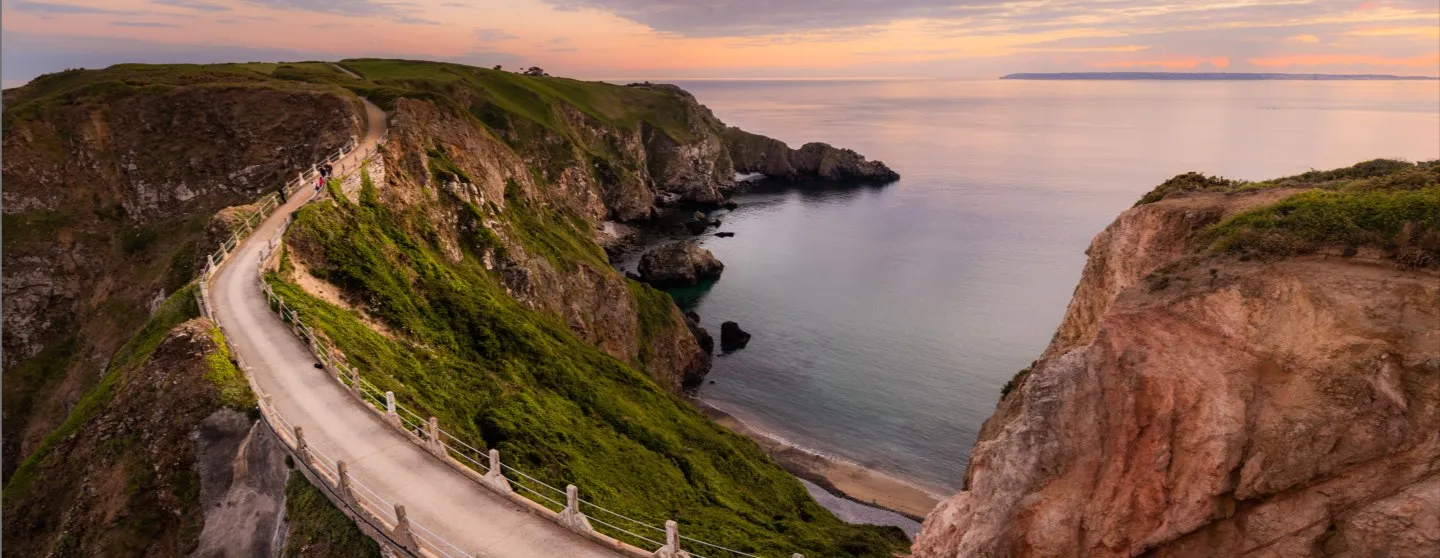
La Coupée is the narrow isthmus joining Sark and Little Sark, with steep drops on both sides.
In Sark folklore, it is haunted by the Tchico, the Witch’s Hound: a monstrous black animal said to be as big as a calf, with flaming red eyes and flaming breath, sometimes dragging a heavy chain, sometimes headless altogether. It was said to pursue those who were about to die. A headless horseman and a floating coffin belong to the same body of stories.
Sybil Hathaway, Dame of Sark from 1927 to 1974, wrote that her childhood pet donkey would not cross La Coupée even when blindfolded. Many islanders took this as a sign that the animal could sense the Tchico.
Sark’s vicar from 1835 to 1877, James Cachemaille, recorded being called to a fisherman who had taken to his bed, delirious, for three days. Caught halfway across the isthmus in a storm, the man had heard a dreadful howl rise from the blackness below and dared not run, for fear of stepping off the edge. Cachemaille believed the sound came from a narrow cave on the Coupée’s eastern shore, where the bodies of American sailors were found after French pirates drove their ship onto a rock still known as Boue Américaine. During southerly gales, the cries are said to still carry from that cave, known as Caverne des Lamentes, the Cave of Laments.
Only one death on the crossing is recorded. In 1731, Philippe Hamon was blown off La Coupée to his death while carrying a corn tithe to Dame Le Pelley. Railings were not put up until 1900. Before then, some visitors crossed on their hands and knees, or lay flat against the path until somebody came to help them.
The tale makes sense in its setting.
Before the crossing was properly protected, La Coupée was a place where wind, darkness and the edge of the path mattered. Islanders turned that danger into the legend of the Tchico.
The Tchico is evidence that generations of islanders regarded this crossing with respect, not evidence of a supernatural animal.
The pouquelayes
Sark folklore also describes the pouquelayes, small Wise Ones said to live in caves and beneath standing stones.
They could help with household tasks when treated well. A saucer of cream might persuade them to finish a difficult piece of knitting. Offend them and they might make somebody lose count, scratch them with brambles or stop the hens laying. The old advice was to leave them alone: n’en prendre ni compte ni taille, take neither count nor tally.
The most memorable detail is that their heads could come off. They were said to dance through caves carrying them beneath their arms.
Pouquelayes were said to live beneath the standing stones that once dotted the island. Writing in 1874, Cachemaille recorded the sites of at least ten cromlechs, though the stones themselves had long since been broken up for building material. Small clay pipes, dug up at Ville Roussell and in fields near the Manoir, were taken as evidence that the pouques smoked, a habit some traced to Walter Raleigh’s introduction of tobacco growing to the islands.
By the early twentieth century, most islanders considered the pouques extinct, though not everyone agreed. One argument in the Bel Air, recorded by Allen de Carteret in The Story of Sark, saw an older man dismiss a fisherman’s claim to have seen a pouque in one of the island’s caves, on the grounds that his own grandfather never had. The fisherman’s reply survives: “Because it didn’t happen to their grandfathers, they think it can’t happen now!”
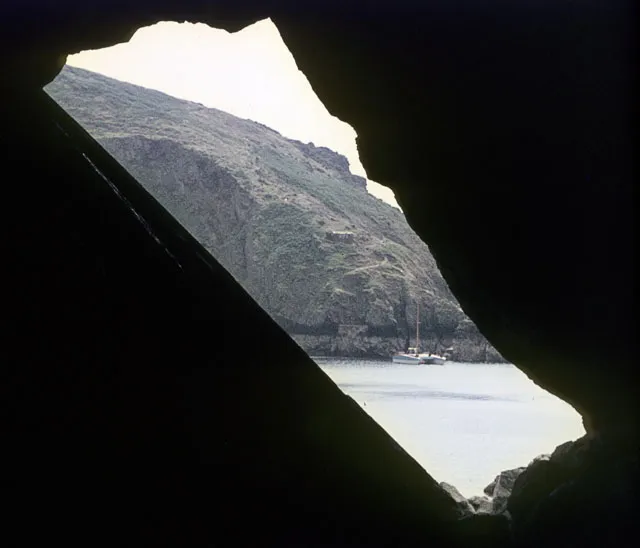
The Gouliot Cave. Sark’s caves gave folklore somewhere physical to live. Photograph by John Rostron, licensed CC BY-SA 2.0.
These are playful stories, but they are also rooted in the island’s physical landscape. Caves, ancient stones and dark corners are not generic scenery. Each gave the stories somewhere to live.
Witches’ Seats
Some old Sark chimneys have small stone ledges beneath the pot.
Folklore calls them Witches’ Seats.
The belief was that witches returning from a Friday night gathering at Grande Grève might need somewhere to rest. A house without a ledge risked a witch coming down the chimney and staying.
The ledges are real. They were originally built to stop rainwater running down the join between a chimney and a thatched roof; fireplace corbels, stones protruding through the gable wall, served the same purpose. Sark’s cottages are no longer thatched, but many chimneys still carry their Witches’ Seats, just in case.
The explanation belongs to folklore.
That distinction is part of the pleasure. A small architectural detail becomes something to look for, and an ordinary chimney acquires a second life.
The smugglers of Havre Gosselin
Smuggling grew as Britain taxed imports heavily to pay for its wars with France, just as Sark’s own knitting trade was collapsing. One story fixes itself to a real anchorage, Havre Gosselin, and a real cave on the south coast of Brecqhou.
Helier de Carteret, a fisherman turned smuggler, used Havre Gosselin to land contraband and stored it in the cave, which local fishermen believed connected to a wider network of tunnels riddled with rats descended from a 1665 shipwreck of plague refugees fleeing London. His son, also named Helier, had left the island to make his own way, then returned and confronted his drunken father in the cave. In the struggle that followed, the son fell and drowned; the father fled and was never seen on Sark again, whether by flight abroad or by throwing himself from the cliff, nobody could say.
Many believed the cave was haunted by the two Heliers afterwards. In 1836, a captain prospecting for copper on Brecqhou found a mound of ash and cinders some three feet deep at the back of it, evidence it had been used for a long time. It is still known today as La Caverne aux Pirates, the pirates’ cave.
La Grande Garce
A ghost known as La Grande Garce is said to haunt La Seigneurie, an apparition of an elderly woman linked to the 1839 drowning of Seigneur Peter Le Pelley and reportedly witnessed by guests and staff over the years.
Peter Le Pelley drowned with his boatman’s party off Bec du Nez in 1839, after disregarding storm warnings and, so the story goes, an ominous apparition seen at La Seigneurie beforehand.
One account, recorded in Sir Edgar MacCulloch’s Guernsey Folk-Lore, describes Frances Carey, who had locked her bedroom door at La Seigneurie, waking around midnight and believing she saw an elderly woman drawing aside the curtains at the foot of her bed. MacCulloch himself allowed the experience may have been a vivid nightmare.
A later edition, with additions by Edith Carey, records a similar account from Caroline, an old servant of the Le Pelley family, and repeats the tradition that the apparition appeared before Peter Le Pelley’s 1839 death.
Stories that belong to the landscape
Sark has other stories too. Sybil Hathaway told American lecture audiences about the island’s White Ladies, including a figure said to haunt Rue Lucas at night and appear as a small white sparrow by day. In 1930, a woman in the gardens of La Seigneurie was so startled to meet a hooded monk chanting Latin that she fell to her knees and prayed; the monk turned out to be a friend of Sybil’s daughter Douce, dressed up in a grey cloak and reciting his old school grace backwards while holding a copy of Winnie the Pooh. A house called La Tourelle, above Derrible Bay, was long avoided by local staff after the mysterious death of a tenant’s wife in the 1870s; her husband’s memorial cross reportedly would not stay standing in the cemetery.
Two grimoires, Le Grand Albert and Le Petit Albert, were said to be indestructible: burnt, buried or thrown into the sea, they would turn up again on the bookshelf. One islander, William de Carteret, is said to have used his own copy to summon the Devil to carry him home rather than walk from Port Gorey. Cachemaille noted that every well on Sark had its own attached legend or ghost; the best known held that at midnight on Christmas Eve, well water turned to blood, and that anyone who went to check would hear their own name called up from the depths and would not live to see the new year.
Not every story needs equal weight.
What makes the folklore valuable is the closeness between story and place, not the size of the catalogue.
You can cross La Coupée knowing the Tchico was said to follow behind. You can notice a Witches’ Seat on a chimney. You can pass caves and standing stones that once belonged to the pouquelayes.
The stories slow down the act of looking.
A cliff is no longer only a view. A chimney is no longer only part of a roof. A dark lane becomes part of the island’s memory.
Sark’s folklore adds another layer to places that were already worth stopping for.
Our very short history of Sark covers the documented history behind the island. The Getting to Sark guide covers the journey here.
