
All Journal stories A History of Sark
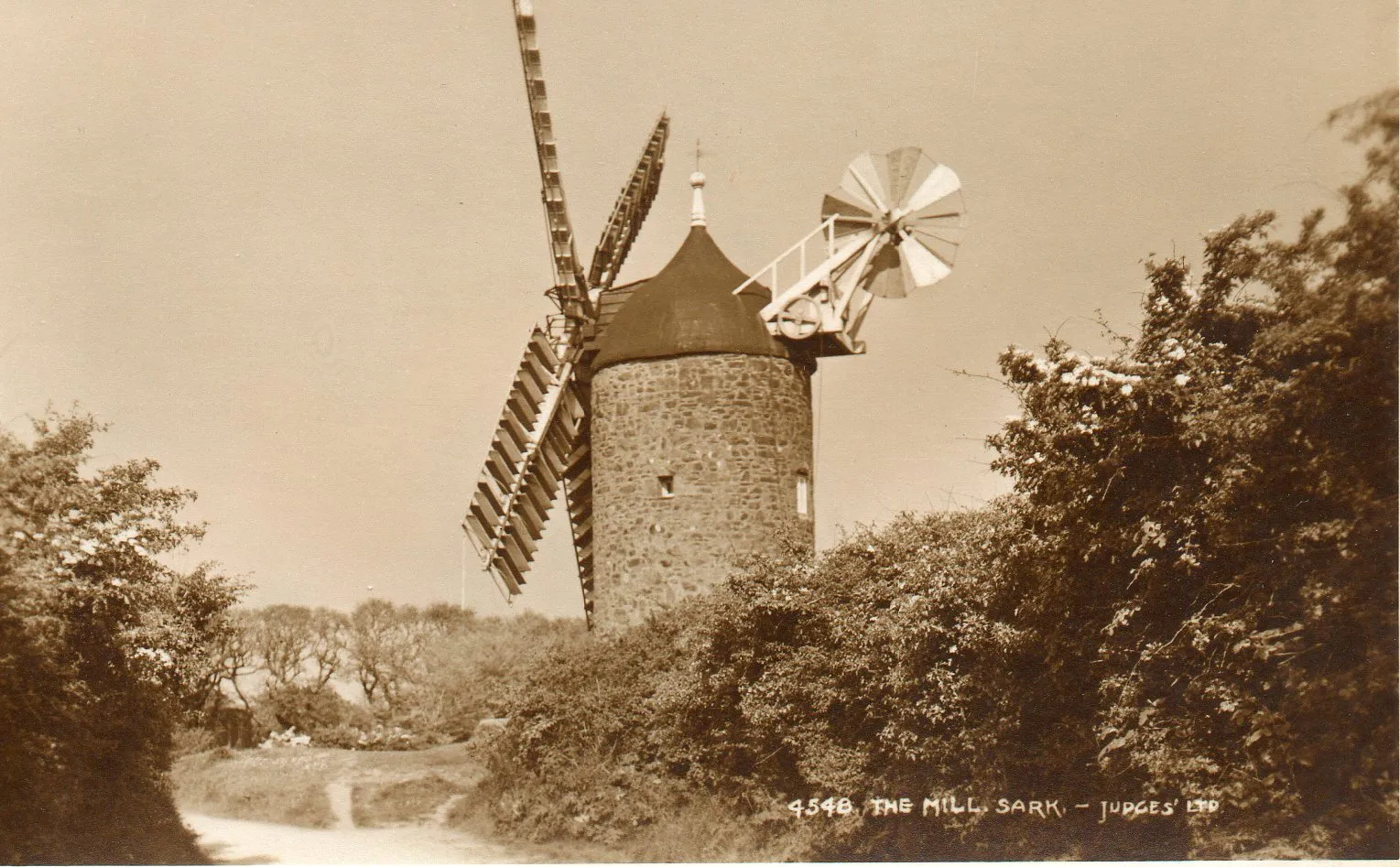
The Sark JournalThe Sark windmill, built 1571
Enjoying the Sark Journal? Get new Sark stories by email.
To understand old Sark, start with the windmill.
It was built in 1571, six years after Helier de Carteret received the island from Elizabeth I and began settling it with forty families.
There was already a mill on Sark when Helier arrived. Monks had run a watermill on the stream above Port du Moulin, and Helier used it for his first crops after he resettled the island in 1563. One watermill could not serve forty new households. The windmill was built to close that gap.
A pink Jersey granite lintel above the north door still carries the de Carteret arms and the date, cut as “L D 1571.” It may be the earliest surviving datestone on a vernacular building anywhere in the Channel Islands.
For centuries, this was where the island’s harvest became its wealth.
Grain was more than food
Grain fed families, but it also settled obligations.
Rents, fees and other dues could be paid in kind. A store of grain therefore represented more than the next loaf of bread. It held value. It could be measured, divided, exchanged and carried forward.
Before grain could become flour, it passed through the mill.
That placed the windmill at the centre of both the island’s food supply and its working economy.
The miller stood in the middle
Every tenant was required to bring grain to the Seigneurial mill. The miller measured what arrived, supervised the grinding and took a share of what passed through his hands.
The fee was around six per cent.
In 1626, the mill tenement of Clos du Moulin was held by a miller named Jean d’Eslandes. Records from that year describe the mill chamber above the grinding floor as dusty but dry and comfortable, with sacks of grain to lie on. It was the highest place on the island, high enough that anyone approaching the grain store could be seen coming from a distance.
That gave the miller an unusual kind of power.
He did not own the harvest, but he stood between the harvest and the form in which it could feed a family, settle an obligation or be used in exchange. Almost every household depended on his judgement, his measures and the machinery under his care.
The monopoly matters because it explains why everyone came to the same place. The more interesting story is what that concentration made the miller.
On an island where grain carried value, the person who measured and processed it occupied one of the most important positions in everyday life.
The building made that importance visible
The mill stood on Sark’s highest ground, about 110 metres above sea level and some 300 metres west of Helier’s own manor house, where it could catch the wind from any direction.
Its position also meant the island could see it.
The tower was not hidden behind the Seigneurie or confined to an administrative building. It stood above the fields whose harvest it processed. The system was part of the landscape.
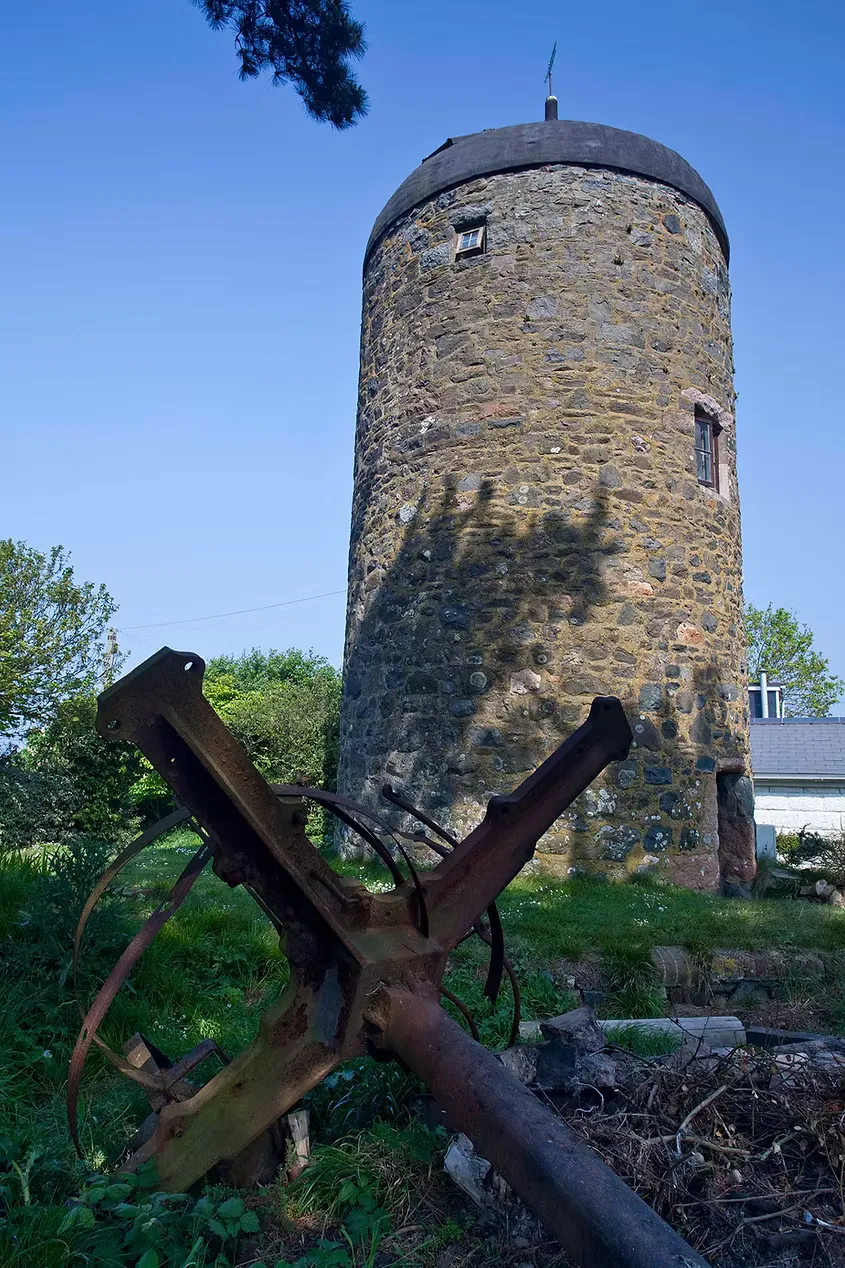
The tower itself is a near perfect cylinder, 4.6 metres across, with walls 0.75 metres thick, originally rising seven metres to a thatched cap before the 1797 fire added the third storey seen today. A timber post mill of the kind common across Elizabethan England would not have survived Sark’s gales. Stone was the only sensible choice.
The tenants also owed mill service. Among other duties, every tenant was required to bring three bundles of straw each year to keep the mill’s thatched roof in repair, a routine, recorded obligation that shows how directly the mill’s upkeep was shared across the island.
The mill therefore brought together land, labour, food and payment in one place.
The fire of 1797
By the end of the eighteenth century, some tenants, at least three of them, had built mills of their own to grind grain without paying the miller’s fee.
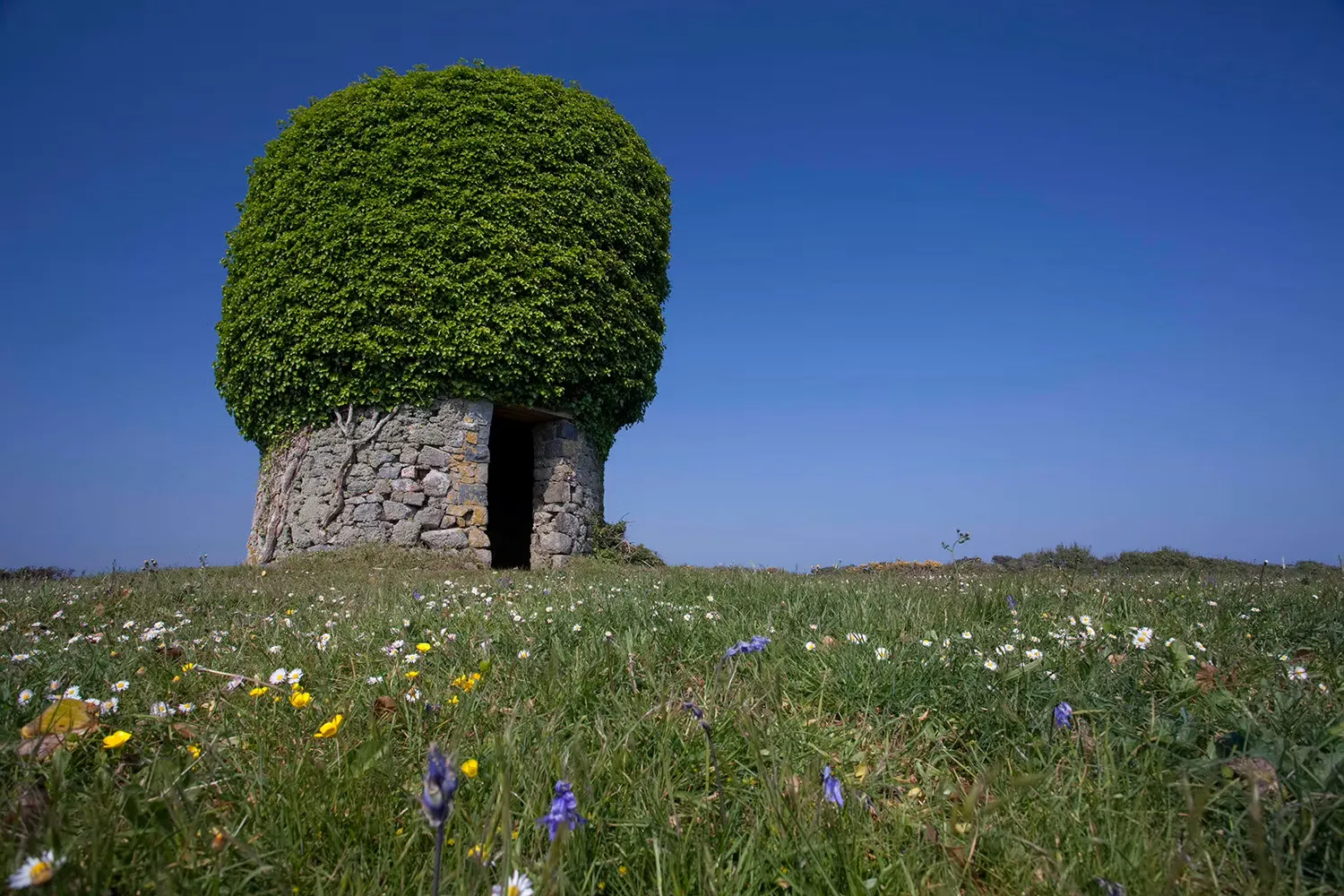
In October 1797, opponents of the Seigneurial system set fire to the main windmill. One of the rival mills, at La Pipeterie in Little Sark, still stands, its stone walls now covered in ivy. Another, on the Hogsback, survives largely as a ruin.
The fire is worth remembering, but it is not the whole story of the mill.
Its importance had already been established by more than two centuries of ordinary transactions: sacks delivered, grain measured, flour collected and the miller’s share removed.
Seigneur Pierre Le Pelley rebuilt and enlarged the tower after the fire. It was raised by roughly two metres, creating the third storey visible today.
A machine that kept changing
The mill was adapted as technology improved.
The original sails, in 1571, were reefed canvas lashed to timber poles, reset by hand from the ground whenever the wind changed. Around 1830, louvered shutters, patented in 1807, and a fantail mechanism were added, allowing the machinery to turn and face the wind automatically, without the miller climbing to reset the sails himself.
The millstones were made from French burr stone, brought from quarries near Paris because local Sark stone was too soft and would have contaminated the flour with grit. When conservators dismantled the runner stone in 2001, they found it had been built from separate pieces cemented with lime, bound with hot iron bands, and balanced with scrap lead packed into four cast iron pots. It weighed close to 400 kilograms.
Timber was just as hard to come by. When Helier de Carteret landed in 1563, he found the island’s trees gone, stripped by rabbits left to breed unchecked, and every working beam and gear in the mill had to be shipped in. Conservation work in 2001 uncovered oak and walnut beams beneath later Victorian pitch pine, timber that had been in the building since 1571. The teeth of the cog wheels were cut from applewood.
Three generations of the Hamon family served as millers through much of the nineteenth century, beginning with Philippe Hamon, engaged in 1830 at £25 a year plus half the profit. His son and grandson, both also named Philippe, succeeded him in turn. The first Philippe Hamon’s initials, PHM, are still cut into the stonework of the upper storey, visible today.
Under Seigneur William Thomas Collins from 1853, the mill reached its peak. Record quantities of wheat and barley were ground in 1856. Decades later, a careful study of the mill’s machinery let Seigneur Michael Beaumont have a scale model built, showing the mill as it worked around 1880. That model has been on display at La Société Sercquaise’s Heritage Room since 2007.
The last money the Seigneur spent on the sails was in 1904, on two new timber arms. A storm broke the sweeps in 1919. Chief Pleas declined to pay for repairs, bringing wind-powered milling on Sark to an end.
The war changed its purpose
German forces took over the mill as a lookout in 1940.
In 1942 it was fortified further. Observation slits were cut into the walls, the surrounding area was mined and the building was adapted for military use.
The roof and much of the remaining machinery were removed. The windshaft was lowered to the ground, where it remains, and a concrete cap was added to the tower.
A building created to process the island’s food had become a military observation post.
Conserved, not rebuilt
Between 2000 and 2002, the mill was conserved rather than returned to working order.
The wartime concrete cap, a two tonne slab sandwiched between rotting timbers in the loft, was broken up entirely by hand. It was not carted away. The rubble now forms the western boundary bank of the property, so the same concrete that once sealed the mill for military use still sits, repurposed, a few steps from the tower. Surviving structural elements and machinery were retained where possible, including the granite stair stubs and the cogging and bearings described above. A new staircase was built using Jersey, Sark and Guernsey stone, with handrails forged by island blacksmiths.
The result carries the evidence of everything that happened to the mill, not a polished reconstruction of how it looked in 1571.
Fields, grain and the miller’s share
The windmill is easy to pass quickly.
It is a small stone tower on open ground. But few buildings on Sark explain more.
Stand beside it and the old island economy becomes easier to see. The fields produced grain. The grain carried value. The miller measured it, took his share and turned the rest into flour.
The mill was where food, payment and authority met.
Stopping here still shows how those three things once fit together.
The very short history of Sark explains the settlement created in 1565. The Getting to Sark guide covers the journey to the island.
