
All Journal stories A History of Sark
The Sark JournalAn island year, 1626
Enjoying the Sark Journal? Get new Sark stories by email.
Sark in 1626 was not a remote idyll.
It was a small, tightly organised community exposed to weather, disease, hunger and the sea. The surviving court minutes, church register and notebooks from the period show an island where almost nothing was private and very little could be taken for granted.
The people are separated from us by four centuries. The pressures they lived under are much easier to recognise.
Forty holdings, one community
Sark’s land was divided into forty tenements held from the Crown through the Seigneur.
Those forty tenement holders formed the core of Chief Pleas, the island’s assembly. It met three times a year, while a smaller body, the douzaine, dealt with the practical work of maintaining the island’s lanes, hedges and shared infrastructure.
This was government at the scale of neighbours. Noe Vaudin, the prevot who carried out the court’s orders, was seventy nine years old in 1626 and had held the post for as long as anyone on the island could remember. He was still doing the job in person: delivering summonses for unpaid rentes, or distraining a cooking pot or a cow when a debt went unpaid.
The court and the church shared a building, not just a community. The first sitting of 1626 fell on New Year’s Day, a Sunday, and the bench sat anyway. Judge Robert Slowley was absent, so the senior jurat, Pierre le Cousteur, took his place. Sunday courts were rare, not only for reasons of doctrine: the same stone and thatch room served as the parish church, which the Reformed congregation always called their temple and never their church. Religious discipline, civil disputes and public decisions were heard within the same four walls.
Discipline reached into ordinary life. Dancing, playing music and even calling someone an unkind name could all be treated as offences under the island’s Reformed church discipline. By the 1620s, the gravest charges, including witchcraft, went to Guernsey’s Royal Court rather than being tried on Sark itself.
Food was power
The island’s economy depended on what could be grown, gathered and carried away by boat.
Grain passed through the Seigneur’s mill, which took a fee of about six per cent. Jean d’Eslandes held the mill tenement, called Clos du Moulin, and every tenant was compelled to bring grain there rather than grind it elsewhere. The chamber above the grinding floor was reckoned the highest place on the island, dusty but dry, with sacks of grain to lie on. In return for the milling monopoly, every tenant owed the mill three bundles of straw a year, to keep its thatched roof in repair.
The Seigneur also controlled cattle breeding through the island’s bull. Vraic, the seaweed used as fertiliser, was important enough for its cutting rights to be regulated by Chief Pleas, and disputes over those rights reached the court. The very first case heard in 1626 was one of them: a Guernsey man, Timotee Vaudin, demanded fourteen reals from two Sark men, Thomas de Carteret and Thomas Poindextre, over bracken and samphire the two of them had cut on Brecqhou, the uninhabited island across the Gouliot Passage. Both men denied owing him anything, and the case was adjourned.
Rock samphire gathered from the western cliffs was packed in brine and exported to ports including St Peter Port, Southampton, St Malo, Rouen and London. Gathering it was dangerous work, a fall from the cliffs could be fatal, and the small boats islanders fished from could just as easily drown a man. On a population this small, either kind of death was felt by everyone. Grain prices were also the assembly’s business rather than the market’s: when Chief Pleas met that February, it set the price of wheat and barley at the same rate per quarter as the year before.
These details matter because they change how the landscape looks. The cliffs were not scenery. The shore provided fertiliser. The mill represented authority. The sea was Sark’s route to markets and its greatest vulnerability.
Rain, plague and strangers
The same year brought excessive rain to Sark, Guernsey and England, and by August it had ruined much of the harvest across the islands. Elie Brevint, Sark’s minister, set the response down in his own register: a fast held “on account of excessive rains in England, Guernsey, and Sark,” the same entry noting plague that summer in Caen, Coutances and Cherbourg.
Nearby towns in Normandy were affected by plague, and Sark renewed an ordinance restricting the landing of strangers for fear of infection.
The island was spared the outbreak. Later that summer Brevint recorded a different kind of relief, passed on by fishermen returning from St Malo: an unusual abundance of cuttlefish along the coast, which he set down as the reason the island avoided worse hunger that year, “otherwise many people would have died of hunger.”
The response reveals how isolation worked in both directions. The sea connected Sark to trade, news and supplies. It could also bring disease or leave the island exposed when crops failed.
In 1627, fear of French privateers led the Privy Council to order gunpowder and munitions for Sark and Alderney. On a small island, events elsewhere were never entirely elsewhere.
What survives
The constitutional language has changed, and so has daily life. The dependence on one mill has gone. Sark’s government was reformed centuries later. Boats, medicine and communication now connect the island to the outside world in ways its seventeenth-century residents could not have imagined.
But the shape of the island still helps explain the records.
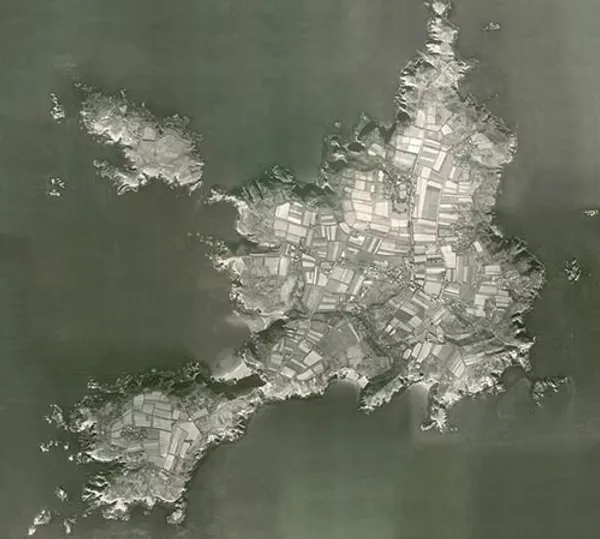
The windmill still stands on Sark’s highest ground. The old tenement pattern remains part of the island’s story. La Coupée still joins Sark to Little Sark. The cliffs that once supplied samphire still fall sharply into the sea.
Walking here gives scale to the history, not a recreation of 1626 itself.
The court, mill, fields and coastline were never abstract institutions or distant places. They belonged to one small island, crossed on foot by people whose lives repeatedly met.
That is what the records preserve, a community working under pressure, not a quaint old Sark.
Our very short history of Sark explains how the island’s political structure developed. The Sark windmill tells the longer story of the building at the centre of its grain economy.
