
All Journal stories Things to Do on Sark
The Sark JournalCycling on Sark
Enjoying the Sark Journal? Get new Sark stories by email.
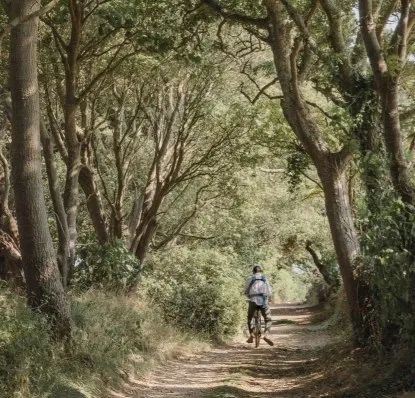
A bicycle gives you more choice.
You still hear the horses. You still stop when the sea appears through a gap in the hedge.
The island is built for choosing a direction
Sark’s lanes can be understood as a handful of routes spreading out from La Colinette, the village hub.
One leads north towards La Seigneurie and L’Eperquerie. Another turns north west towards Port du Moulin. The western lanes reach the Gouliot and Havre Gosselin. South takes you towards La Coupée and Little Sark. A shorter eastern route heads towards Point Robert.
This makes navigation unusually simple.
You do not need to plan an exact circuit before leaving. Choose a direction, ride until the lane becomes a track or path, leave the bicycle and continue on foot.
The bicycle takes you across the plateau. The coast still asks you to approach at its own pace.
The lanes are not roads without cars
Sark has no tarmac and no made roads, apart from the concrete crossing at La Coupée.
Its network is made of lanes, tracks and paths, roughly 22 kilometres of them in total.
The island is car free for residents and visitors, but it is not vehicle free. Tractors move freight and materials, and are kept off the lanes between 10pm and 6am. Horse-drawn carriages share the lanes. Walkers, cyclists and working traffic all use the same narrow space.
That requires attention rather than speed.
Cycling here is relaxed because the island is not arranged around private cars.
La Coupée changes the journey
The most memorable ride is south towards Little Sark.
La Coupée is the narrow isthmus joining the two parts of the island, with long drops towards the sea on either side.
Bicycles should be walked across it.
That interruption matters. You dismount, slow down and cross on foot. The journey changes before Little Sark begins.
The crossing itself is concrete, laid in 1945 by German prisoners of war under Royal Engineers supervision. A small plaque at the Little Sark end still commemorates them.
Once you are riding again, the lanes of Little Sark go quieter still. It is entirely possible to cover a stretch of them without meeting another person.
A bicycle expands the day
Sark is around three and a half miles long and one and a half miles wide.
On a map, that can look too small to justify hiring a bicycle. In practice, the coastline folds around bays, cliffs and headlands, and many coastal places are reached only after leaving the lane.
Cycling gives you time to explore more than one part of the island without turning the day into a list of attractions.
You can ride north, walk onto a headland, return through the village and choose another direction after lunch. You can reach the top of a descent, leave the bicycle and continue towards the sea.
Standard or electric bicycle?
There are four cycle-hire businesses in the Village area, among them Avenue Cycle Hire near the top of Harbour Hill, with standard and electric bicycles available.
A standard bicycle is enough for many visitors. Sark is compact, but changing surfaces add effort.
An electric bicycle can make sense for anyone who wants the freedom to range across the island without making the hills the main event.
What to carry
Water. Layers for changing weather and a small bag that leaves your hands free.
Some parts of the island, including Little Sark and L’Eperquerie, have few or no services close by.
Bicycles are not permitted on the cliff paths. Leave the bike where the rideable route ends and continue on foot.
Why cycling belongs to Sark
In many places, a bicycle is an alternative to the transport system.
On Sark, it is the transport system.
A bicycle gives you more ways to keep exploring Sark.
Our getting around without cars article explains how walking, carriages, tractors and the toast rack fit together. The Getting to Sark guide covers the ferry, arrival and luggage.
