
All Journal stories Nature on Sark
The Sark JournalThe rocks of Sark, two billion years underfoot
What the cliffs and the beach pebbles are made of, and how old it all is
Enjoying the Sark Journal? Get new Sark stories by email.
How old are Sark’s rocks?
Most of Sark stands on rock about two billion years old. Geologists call it biotite gneiss, and it is the country rock of the whole island apart from Little Sark. A newly exposed surface is a glittery grey, often streaked with pale quartz and feldspar.
One geological account of Sark traces that gneiss back to its probable beginning as sedimentary mud mixed with lava. Since then it has been folded, crushed and weathered through many episodes of metamorphism, which is why the same rock can look quite different from one corner of the island to another.
The gneiss has company of a similar age. Hornblende gneiss, dark green or black, often carries bands of pale granite and pale green epidote, a mineral usually associated with altered hornblende. Augen gneiss, an altered granite with large eye shaped feldspar crystals, is more common on Guernsey and Alderney; on Sark it appears only at Maseline Harbour and on Les Burons.
The dark granite of Little Sark
The granite on Sark carries an unusually high proportion of dark mica, which makes it darker than ordinary granite and, technically, a diorite. It was intruded into the older gneiss about 680 million years ago, in the Pre-Cambrian, and it makes up the whole of Little Sark as well as the island’s northern tip at L’Eperquerie. A separate sheet of granite runs through the central section of the island, visible in the cliffs of the east and west beaches.
The dykes that cross the island
All of this old rock is criss-crossed by intrusive dykes running roughly east to west. They formed where cracks in cooled, brittle rock reached molten magma below, which rose to fill them, leaving seams of different rock through the older stone. Three kinds occur on Sark. Dolerite is a smooth black or dark grey rock related to basalt and gabbro. Felsite is whitish, made of quartz and feldspar, and tends to follow the dolerite intrusions. Lamprophyre is a comparatively rare, dark, earthy rock rich in mica, hornblende and olivine.
The sparkle in the black rock
Some of Sark’s dolerite is porphyritic, carrying unusually large feldspar crystals beautifully distributed through the black rock. This stone is thought to have attracted the attention of Neolithic people on the island. Neolithic hands certainly worked dolerite: over 120 stone axes have been found on Sark, some imported from France and others made from a local dolerite quarry.
Between 2023 and 2025, archaeologists excavated the L’Ecluse mound, on the path towards Port du Moulin, and found it to be a natural feature, a dyke of dolerite intruded into the island’s older gneiss. It had, though, been artificially cut back and shaped in prehistory, and among the finds was a scattering of broken white quartzite, likely placed, in the excavators’ reading, for its sparkle in sunlight. People kept coming back to the spot: the dig also recorded a timber structure radiocarbon dated to around AD 600, a large pit holding 15th or 16th century pottery, and small pits from a 19th century planting scheme.
Both claims are worded carefully. The geological reading is “thought to have”, the excavators’ is “likely”, and the shaping of the mound is dated only to prehistory. If both readings are right, the same sparkle of pale crystal in dark stone caught eyes on this island in ages far apart.
The youngest rocks in the Channel Islands
The lamprophyre dykes came last. They intruded all the rocks of the Channel Islands around 280 million years ago, during the Permian, which makes them the youngest rocks in the islands. They originate from deep below the Earth’s crust, and their high carbon dioxide content is thought to have driven them upward rapidly.
Two billion years in a Sark pebble
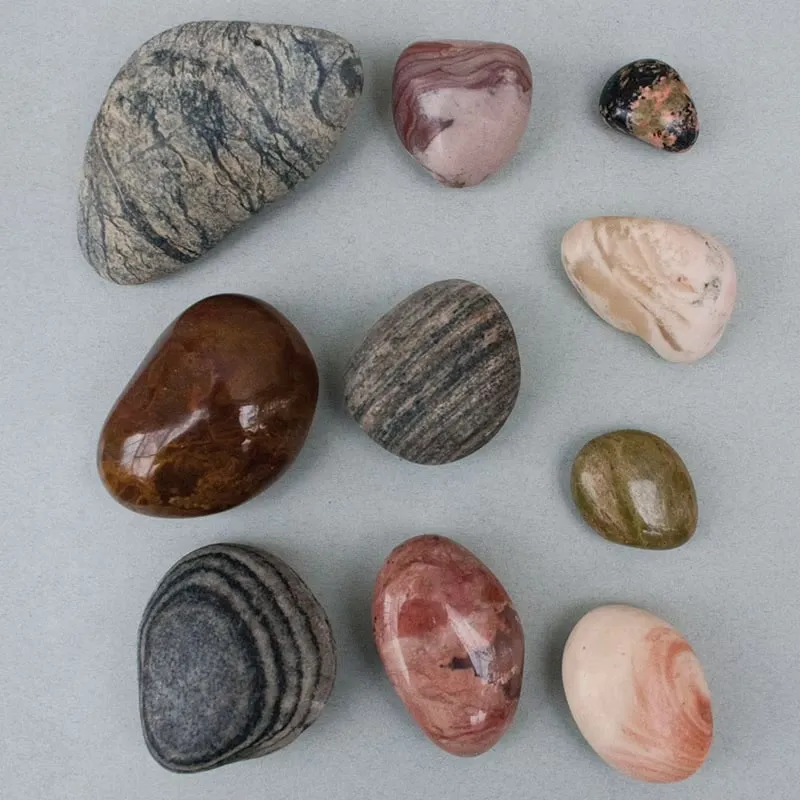
None of this needs a hammer or a field trip. The cliffs, the seams that cross them and the pebbles below are all within reach of an ordinary afternoon walk, and our guide to Sark’s rocks shows what each rock looks like, so you can check a pebble against it on the beach. A glittery grey one, streaked with pale quartz and feldspar, may have been rock for about two billion years before it reached your hand.
This article follows one geologist’s account of the island’s rocks, published as Sark Rocks and available from La Société Sercquaise.
