
All Journal stories The German Occupation of Sark
The Sark JournalA walk through what the Occupation left behind
Ten ordinary places on Sark where the island's Occupation history is still visible
Enjoying the Sark Journal? Get new Sark stories by email.
Sark’s Occupation history sits inside ordinary places, a harbour, a bank site, a post office, a field. This is a walk through ten of them, not in the order the events themselves happened in.
Creux Harbour
The first German officers arrived here on the morning of 3 July 1940. On 10 May 1945, a British detachment of three officers and twenty men came ashore here and travelled by carriage to the surrender.
A plaque, unveiled in 2015 by Nellie Le Feuvre, the last surviving Sark deportee then still living on the island, commemorates the 62 people deported from Sark.
The Seigneurie
The Seneschal escorted the first German officers here from the harbour on the day they landed. At the start of the Occupation, Dame Sibyl Hathaway had bottles of champagne buried in the garden; she had them dug up the day the surrender was signed.
The site of the Bel Air Hotel
German soldiers had their first billet at the Bel Air, at the top of Harbour Hill, where the HSBC Bank is now. A curfew bell once hung outside the hotel.
On 26 January 1942, a stove flue running through the old thatched roof started a fire. Thirty tons of coal stockpiled in the building made the blaze impossible to put out. The hotel was never rebuilt.
The Gallery
Eric and Lisel Drake built the Gallery in 1933 for the Sark Art Group; it is now the Post Office. The German garrison used it to store ammunition during the Occupation. Works by Mervyn Peake, who had lived on and painted Sark in the 1930s, were among the items kept here.
A tree outside it became known, for an entirely different reason, as the Traitor’s Tree, after a list of hidden radio owners was pinned to it and handed to the German Kommandant, who destroyed it rather than act on it.
Eperquerie Common
The Sark Visitor Centre’s 2020 account of the Occupation, Sark: An Island Occupied, records that InselKommandant Hauptmann Johann Hinkel was killed here on 28 March 1943. He had stepped on a German mine.
La Coupée
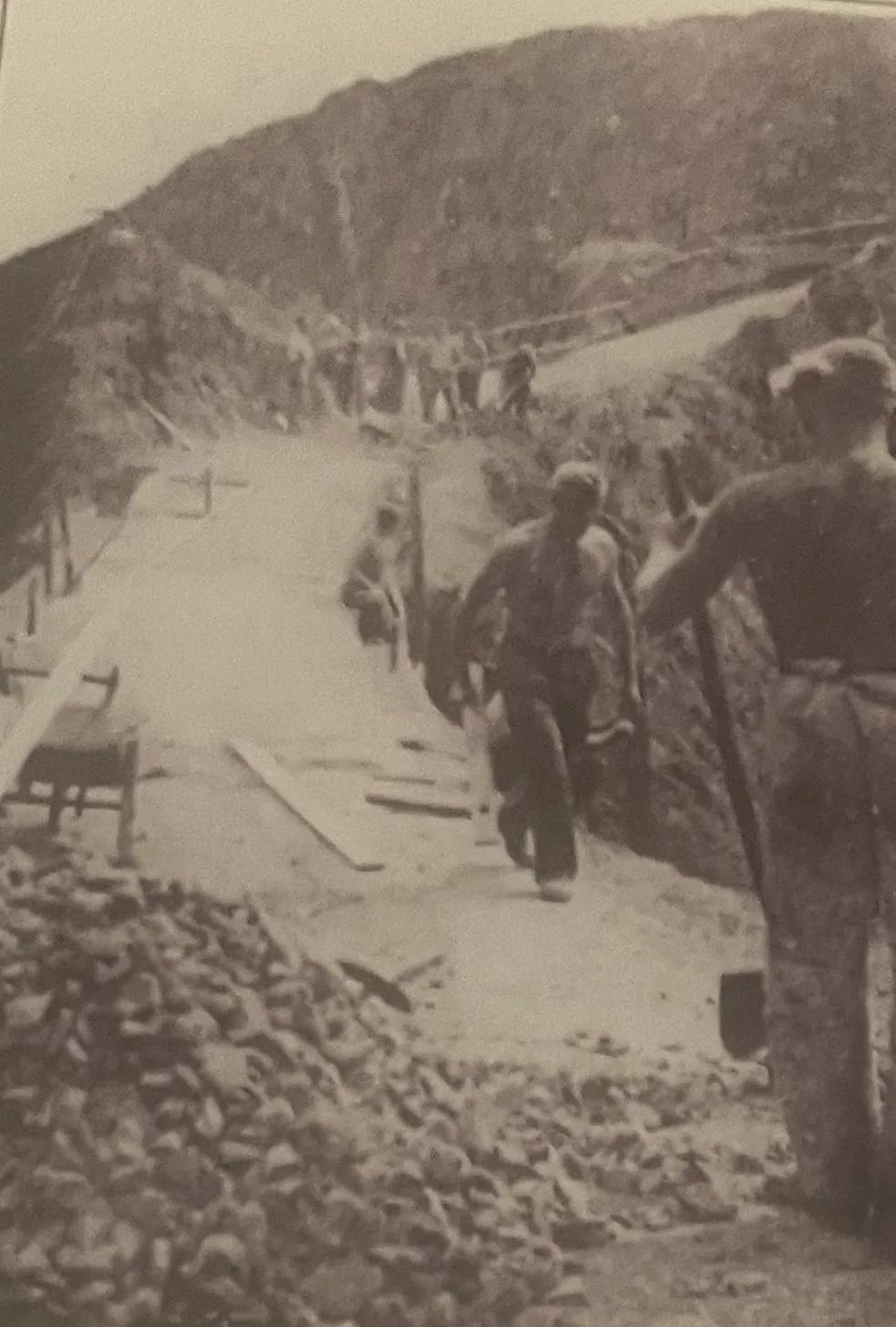
La Coupée is the narrow isthmus between Sark and Little Sark. After Liberation, German prisoners of war, supervised by the Royal Engineers, resurfaced the crossing in concrete and added handrails.
The Mill
The mill was fortified in August 1942 with a machine gun and a searchlight.
The graveyard opposite St Peter’s Church
The occupying troops buried two commandos in the small military section here in December 1943. Corporal Robert Bellamy and Corporal André Dignac were killed by mines during Operation Hardtack 7, the final British Commando raid of the war on the Channel Islands. Dignac’s remains were later exhumed and repatriated to France; Bellamy’s grave is still on Sark.
Aeroplane Field
A damaged RAF Lancaster bomber crash landed in this field, opposite Seigneurie Farm, on 23 November 1942. Its pilot, Flight Sergeant Eric Singleton, brought it down safely. The field has been known as the Aeroplane Field ever since.
The site of the Sark Visitor Centre
The Sark Visitor Centre stands on the site of the Junior School. The Germans used the school as their main food dump. When British forces made their reconnaissance after the full relief on 17 May 1945, they found 57 sacks of white flour, one and a half tons of coal, and 600 litres of petrol.
It is where the booklet behind this walk is sold today.
For the wider story from 1940 to 1945, read Sark in the Second World War.
