
All Journal stories Witchcraft, Magic and Mystery
The Sark JournalSark's Witch Trials
Enjoying the Sark Journal? Get new Sark stories by email.
Sour milk and a cat that would not leave her. That is what later correspondence about the case says lay behind Rachel Alexandre’s conviction for sorcery in 1627. Her own surviving court sentence, by contrast, names no specific evidence at all.
She lived at La Sablonnerie, on Little Sark, and the record of what happened to her and her family survives in Guernsey’s own court archive.
A family alone at La Sablonnerie
Rachel’s husband, Jean Nicole, came under suspicion of sorcery from around 1612. He was arrested about 1619 and held in Castle Cornet, Guernsey’s sea fortress and main prison, where he was examined three times and denied every charge. The court sentenced him to be whipped to bleeding at every crossroads in St Peter Port, to have one ear nailed to the pillory and cut off, and to be banished forever from the Bailiwick, which then included Sark. Two surviving accounts give different years for that sentence, 1618 and 1620.
Rachel then ran the farm alone with the children for seven years.
In early 1627, the officers of Sark brought charges against Rachel, her sister Judith Alexandre, and her stepson Job Nicole. All three were taken to Castle Cornet. Rachel was held there six months before her case was heard.
What was said against her
What was alleged against her was small and ordinary: milk that had turned sour, and a cat that had taken to following her, reported afterwards in correspondence about her case rather than in the court’s own surviving sentence. A separate case from 1617 shows what could count as witchcraft evidence in practice: illness, livestock, failed milk, lice and objects believed to be charms. Historians call this pattern the charity refusal model, a modern term, not a period one, for cases in which a marginal or isolated person is refused something by a neighbour, who then blames a later misfortune on them. An unaccompanied woman keeping a farm going without a husband for seven years fit that pattern before she was ever formally accused of anything.
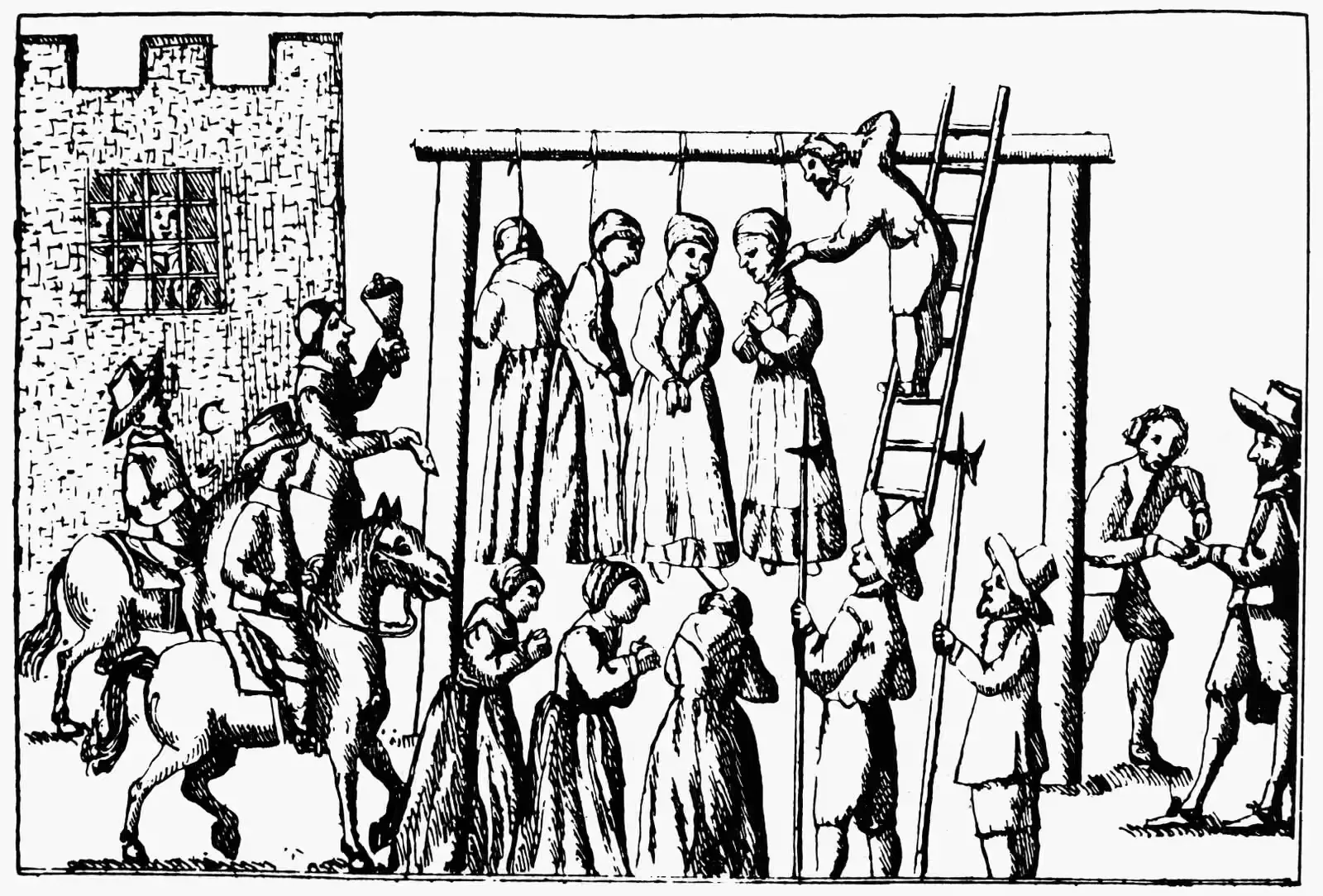
On 25 August 1627, Rachel was convicted of sorcery. Her sentence ordered that she be tortured first, by the strappado, to try to make her name others, then hanged and strangled to death, her body burned and reduced to ashes. Judith Alexandre and Job Nicole were banished the same day, led onto the beach between the tides in the formal ceremony of expulsion known as la mare.
Guernsey’s court applied torture after conviction; Jersey’s did not. Those tortured were made to name others said to have attended a sabbat, which is why a single Guernsey conviction could generate further arrests, and why the sabbat appears almost nowhere in Jersey’s own records. 1627 was also one of a small number of years, alongside 1563, 1585, 1591, 1617 and 1631, in which prosecutions across the islands clustered. Historians have traced that pattern to plague years, when fear of outsiders and unexplained misfortune both ran high.
Healers courts prosecuted too
Rachel’s own case never mentions a devin, but the wider climate she lived under drew a constant line around who was allowed to know things. Guernsey and Jersey both had devins, cunning men and wise women, folk healers and diviners sometimes called white witches, consulted whenever plague or misfortune struck. Courts prosecuted not only the devin but anyone who sought one out: a 1591 Jersey ordinance held a devin’s client as culpable as the devin themselves. A devin’s actual craft was mostly remedies and cures, not curses.
That knowledge did not disappear when the courts did. Sark still holds an annual Foraging Weekend, and the same cliffs that once exported rock samphire by the barrel still carry it today, alongside wild thyme, gorse and sloes gathered for autumn sloe gin. What was once evidence against a woman is now simply how some people spend a Saturday on Sark.
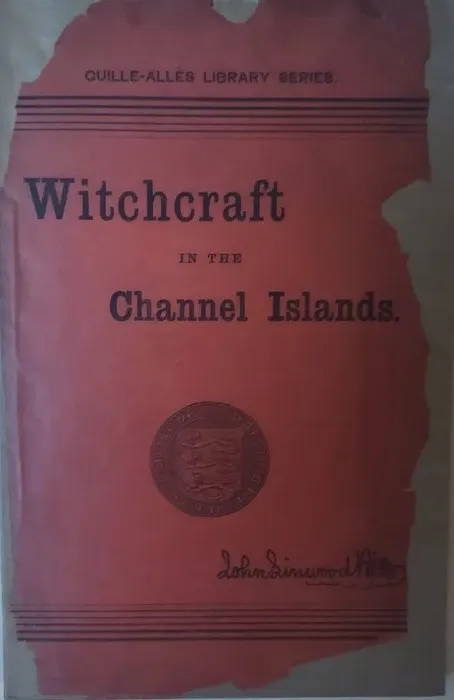
A period study of witch trials across the Channel Islands, the same body of court record this piece draws on.
What the record does not agree on
Guernsey’s own court records name four different Sark residents brought before it on witchcraft charges between 1617 and 1631: Philipine le Parmentier, a widow named as the wife of a Nicolle of Sark, hanged and burnt in October 1617; Jean Nicolle, whipped and banished; Job Nicolle, banished in 1627; and Jehan Nicolle, set at liberty in 1631. Rachel Alexandre does not appear on that list at all, and Philipine le Parmentier does not appear in the family’s own timeline.
Whether these are the same people listed twice, under different names, or a larger group than either source shows on its own, is not settled. One often repeated account puts the number of family members caught up in the trials at five. The sources behind this piece document four by name in each account, and any fifth person remains untraced. No total is safe to state here, and this piece does not attempt one.
This is a record of what a court, working under Norman law that allowed no right of appeal, could do to people accused by their neighbours. Nothing in it shows that Jean, Rachel, Job or Judith practised anything. It shows what they were accused of, and what was done to them for it.
Alone on the island, then and now
Rachel Alexandre’s isolation was not incidental to what happened to her. A woman running a farm with no husband, answerable to no one, was already something her community and her court both noticed before a single accusation was formally made against her.
Little about Sark’s geography has changed since 1627. Sark is still car-free, still without street lighting, still small enough that people notice one another. What has changed is what those same conditions mean for a woman alone. Rachel Alexandre did not have that safety.
What the charge really was
Sour milk and a cat were never really the evidence. The disqualifying fact was that Rachel answered to no one: no husband on record, running the farm on her own judgement, for anyone nearby to take against. Read plainly, that description fits any woman living independently: unmarried, widowed, divorced, simply managing her own life without asking permission. Witchcraft was the charge on paper. What the court was really testing was whether a woman could be left alone.
What Sark offers women today
On Sark you can walk back after dark, alone, and think nothing of it. More on that is on our women travelling solo and women’s wellness retreat pages.
Some of that same territory shows up quietly today, away from any programme. Nadia hosts informal women’s circles on Sark, held in each other’s homes rather than any fixed venue. Nothing about it is advertised or bookable. It is simply how some women on the island spend an evening together, the ordinary version of what Rachel Alexandre was never allowed.
The word means something different now
Four hundred years ago, the word convicted a woman for managing her own life without anyone’s permission. Some women today are choosing that same word for themselves, on their own terms, not a charge placed on them but an identity they claim. That shift is not distant. In Jersey, a short crossing from Sark, a writer researching the island’s own trial history for a ballet company describes spending time with what he calls a “flourishing community of modern-day witches”.
An idea worth asking about
Reading Rachel Alexandre’s case straight, without inventing anything either way, is one thing. Whether that present-day shift belongs as part of a stay on Sark is a separate, open question we are asking, not answering. Nothing has been built yet. Read the idea, and tell us if you would come.
