
All Journal stories Restoration
The Sark JournalYour body thinks emails are predators
Stress is useful in short bursts. But what happens when the body keeps preparing for danger after the danger has passed?
Enjoying the Sark Journal? Get new Sark stories by email.
We have all experienced that particular kind of email or text message that can change the atmosphere before you have even opened it.
We need to talk.
Nothing has happened to your body in the ordinary physical sense. You are still sitting at the same desk, in the same chair, with no need to run anywhere. Yet attention tightens, the shoulders may follow, and the next few moments can feel very different from the few that came before.
The predator comparison only goes so far. Your inbox is not a wolf, and your nervous system is not confused about that. But psychological and social demands can recruit the same broad stress-response machinery that helps us mobilise when something requires action.
That machinery exists for good reason. The problem is that so many modern stressors do not come with a clean ending.
Stress is useful until it doesn’t end
Stress has acquired such a bad reputation that it is easy to forget what it is for. A short-term physiological stress response helps the body meet a challenge.
The difference between short and long stress is especially clear in the immune system. In a 2014 review of stress and immunity, Stanford researcher Firdaus Dhabhar describes short-term stress, lasting minutes to hours, as capable of enhancing some innate and adaptive immune responses. Long-term stress can do the opposite, suppressing or dysregulating protective immunity.
The aim is not to stay calm all the time. A useful stress system has to be capable of switching on. It also has to be capable of standing down.
Standing down is harder when the source of stress has no obvious finish line. A difficult meeting may last an hour but occupy the rest of the afternoon. Financial uncertainty can persist for months. A family problem can be present while you cook, commute and try to sleep.
Work now travels remarkably well. The device that delivers the problem also fits in a pocket and sits beside the bed. The stressor may be intermittent, but the possibility of another demand remains available almost continuously.
Chronic stress is therefore not simply a more intense version of a stressful morning. Here, chronic means stress that persists or is repeatedly renewed over time, rather than a brief response that rises and subsides. Duration changes what the body is being asked to do.
What stress can reach
One of the clearest demonstrations that psychological stress is not confined to mood came from a deliberately odd experiment published in the New England Journal of Medicine in 1991. Researchers gave 394 healthy subjects nasal drops containing one of five respiratory viruses, then quarantined and monitored them. As measured psychological stress rose, so did rates of both infection and clinical colds, in a dose-response pattern.
The design controlled the viral exposure tightly. The exposure was experimental, and the researchers adjusted for a long list of alternative explanations including age, sex, season, allergies, weight and pre-existing antibody levels. Stress itself was measured rather than experimentally assigned, but under the same controlled viral challenge, people reporting higher psychological stress were more likely to become infected and to develop a clinical cold.
Wound healing offers another striking example. In a 1995 Lancet study, 13 women caring for relatives with dementia and 13 matched controls were given a standard 3.5 mm biopsy wound. The caregivers’ wounds took 48.7 days to heal on average, compared with 39.3 days in the control group, a difference of more than nine days. It was a small study, and stress was not assigned, since the comparison was between caregivers and matched controls. The difference was statistically significant, and it suggests that sustained psychological strain may reach a process most of us would not ordinarily describe as psychological.
There is no universal amount of stress after which the body suddenly becomes unhealthy. Stress is not measured like blood alcohol. People differ in what they are exposed to, how long it lasts, what else is happening in their lives and how much opportunity they have to recover.
Behaviour and physiology also overlap, which is one reason the effects of prolonged stress are difficult to separate neatly into “mental” and “physical” categories.
The problem with a nervous-system reset
The internet has found a more fashionable word than stressed: dysregulated. From there it is a short step to the promise of a nervous-system reset. A Guardian report on the trend, published on 2 October 2026, lists cold water, humming, tapping and specialist mats or devices among the online suggestions.
We are not suggesting that these things are useless. The same report describes short-lived physiological effects for several of these practices while rejecting the reset claim: experts it quotes say there is no literal nervous-system reset and that a healthy system adapts to changing circumstances.
A better target is flexibility. The body needs to mobilise when a situation demands it and to recover when the demand has passed.
Slow breathing is a useful example because the evidence is real without requiring extravagant claims. A 2022 systematic review and meta-analysis covering more than 200 studies found that voluntary slow breathing increased measures of heart-rate variability associated with parasympathetic influence during breathing, immediately afterwards and after repeated practice. In ordinary language, deliberately slowing the breath can shift the heart towards a pattern associated with rest and recovery.
Movement can help too. Walking has evidence behind it for mood and anxiety, and the same report notes that standing and moving can interrupt the fixed, contracted state of prolonged sitting. But a breathing exercise does not reduce a workload, and a walk does not resolve a relationship that is causing sustained distress. Techniques that change your state can be useful without becoming an argument for tolerating whatever keeps putting you into that state in the first place.
For persistent stress that is affecting sleep, mood, daily functioning or the ability to cope, professional support may be appropriate. Sometimes the practical intervention is medical or psychological care. Sometimes it is a conversation, a boundary, fewer hours, more help, or a decision that is difficult precisely because the source of the stress is real.
Recovery is partly an environmental question
Recovery is the phase of a functioning stress response in which the immediate demand has passed and the body is no longer being asked to keep preparing for it. Modern life is exceptionally good at extending the first half of that cycle. Work follows us home, arguments replay themselves and news arrives on demand. The body can still mount a real stress response when the trigger is social or psychological rather than physical.
A useful question is whether the day contains enough moments in which nothing new requires a response. Nature appears repeatedly in conversations about recovery, although the research is easier to oversell than the landscape.
In a 2018 Japanese study, 485 men walked for about 15 minutes at 57 forest and 57 urban sites. On average, their heart-rate patterns shifted in the direction the researchers associated with greater parasympathetic and lower sympathetic activity in the forests. In plain English, the average pattern looked more like rest and recovery in the forest than in the city. The response was not universal: roughly two-thirds of participants moved in the expected direction on each of the two measures, while others did not.
A 2019 systematic review and meta-analysis also found lower salivary cortisol in forest groups than urban groups, although most of the evidence concerned short-term exposure and the studies varied considerably.
Neither finding turns a coastline into a treatment for chronic stress, and neither proves that five days on Sark reproduces what happened in a Japanese forest. Taken together, those findings make a narrower point: environment can be associated with measurable differences in physiological state.
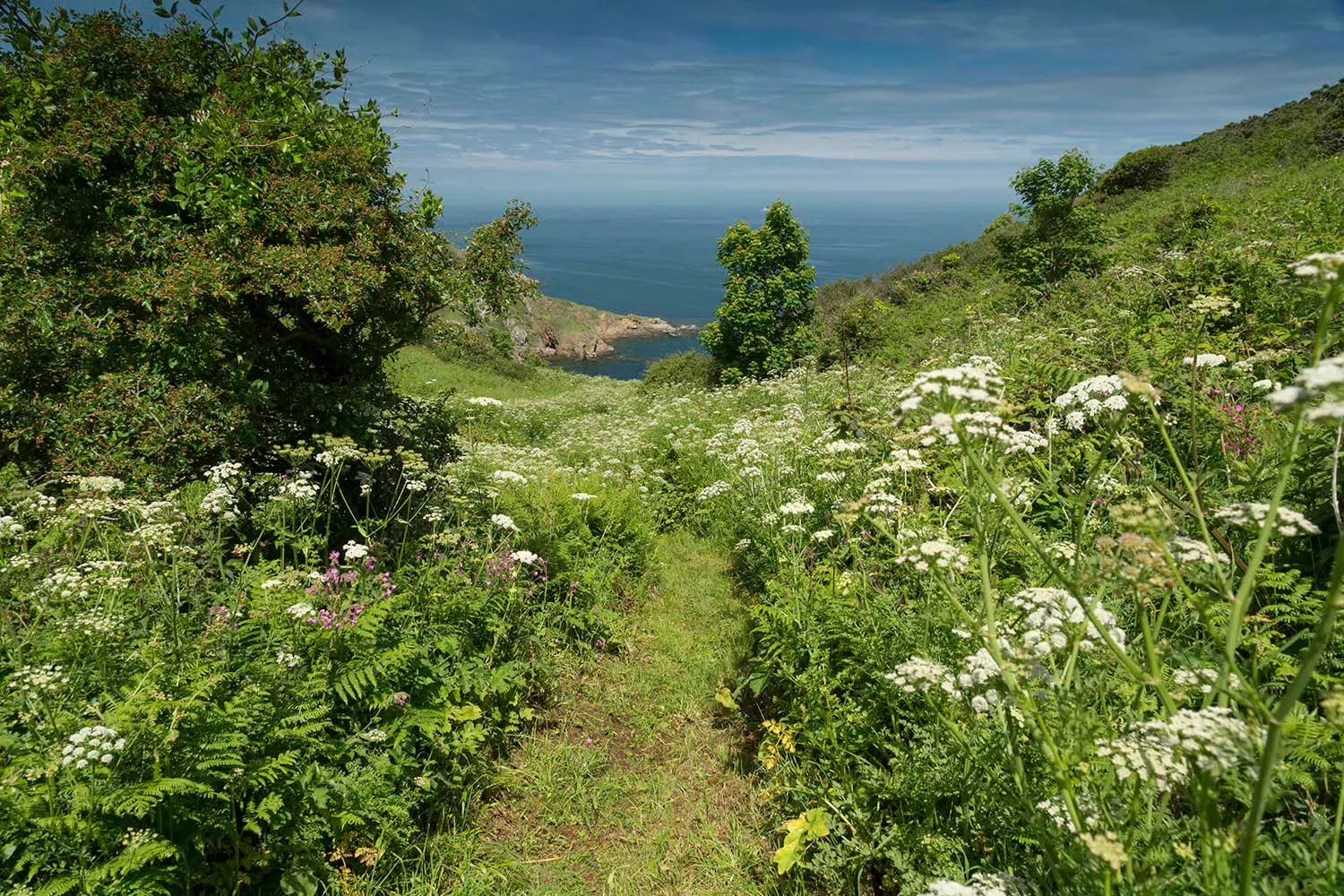
Sark is useful here because that environmental difference is easy to feel. The island is car-free, so walking is part of ordinary movement. The sea is rarely far away, and moving water is one of the natural stimuli used to explain what attention researchers call “soft fascination”: something that holds attention without demanding much effort. There is no street lighting, so darkness arrives without the constant glow that follows most of us through towns and cities.
These are simple facts, not clinical claims. The sea, weather, paths and darkness can occupy attention without behaving like another inbox.
That distinction matters to us because we run retreats here. The island is not a treatment and a week away is not a cure in itself. Our article on what a week can and cannot do for burnout deals with that question directly, including the evidence that benefits from a break can fade after people return to unchanged circumstances.
Time away can still be useful because it makes contrast visible. We see retreat participants use the week to think about the architecture of their lives: what they want to return to, what they want less of, and which parts of their ordinary environment keep them permanently on call. The week creates room to ask those questions with fewer interruptions; what follows from them still belongs to the person going home.
That is one of the things our retreats offer: fewer demands, no cars, more walking, darkness at night and long stretches of the day that are deliberately left open. It may be less marketable than a “nervous-system reset”, but it is closer to what recovery actually means.
Come and feel the difference for yourself. Even the journey changes the pace: the crossing to Sark is part of it.
