
All Journal stories Murder, Ghosts & Things in the Dark
The Sark JournalThe warning above Havre Gosselin
Five men were warned not to sail. A widow turned what happened next into one of Sark's starkest memorials.
Enjoying the Sark Journal? Get new Sark stories by email.
Five men left Sark at five o’clock on an October evening in 1868.
The weather was getting worse.
Local boatmen had warned them not to go.
None of the five came back alive.
Above Havre Gosselin, a granite monument now records their names and the weather that followed them out of the bay: a squall, heavy rain and thick darkness.
The inscription ends with two words chosen by the widow of one of the dead men.
Caution and warning.
The Pilcher Monument reads less as a memorial to a Victorian accident than as a message aimed at the next person tempted to believe that a necessary journey makes the sea less dangerous.
The departure
On 19 October 1868, Jeremiah Giles Pilcher, an oil merchant from London, Agnew Giffard, his brother Walter J. Giffard, Dr C. S. Gatehouse, a medical officer travelling to Alderney, and the boatman Renouf embarked from Havre Gosselin.
Agnew Giffard was the engineer in charge of the Creux Harbour breakwater works, and made the crossing from Guernsey monthly to inspect them. He had urgent business back in Guernsey, and the party looked to return the same evening.
The memorial gives the departure time as 5 pm.
Local boatmen had already warned the party of poor weather and tidal conditions and advised them to wait until the next morning.
They left anyway, reefing their sails before they had even cleared the bay.
The warning matters because this was not a case of danger arriving without notice.
People who knew the local water had told them what they thought.
Their reasons for leaving did not change the weather or the state of the sea.
Heavy rain and thick darkness
The monument itself supplies the next part of the story.
Soon after the five men left, a squall rose with heavy rain and thick darkness.
Those words are carved into stone above the same bay.
They are unusually effective because the setting has not disappeared.
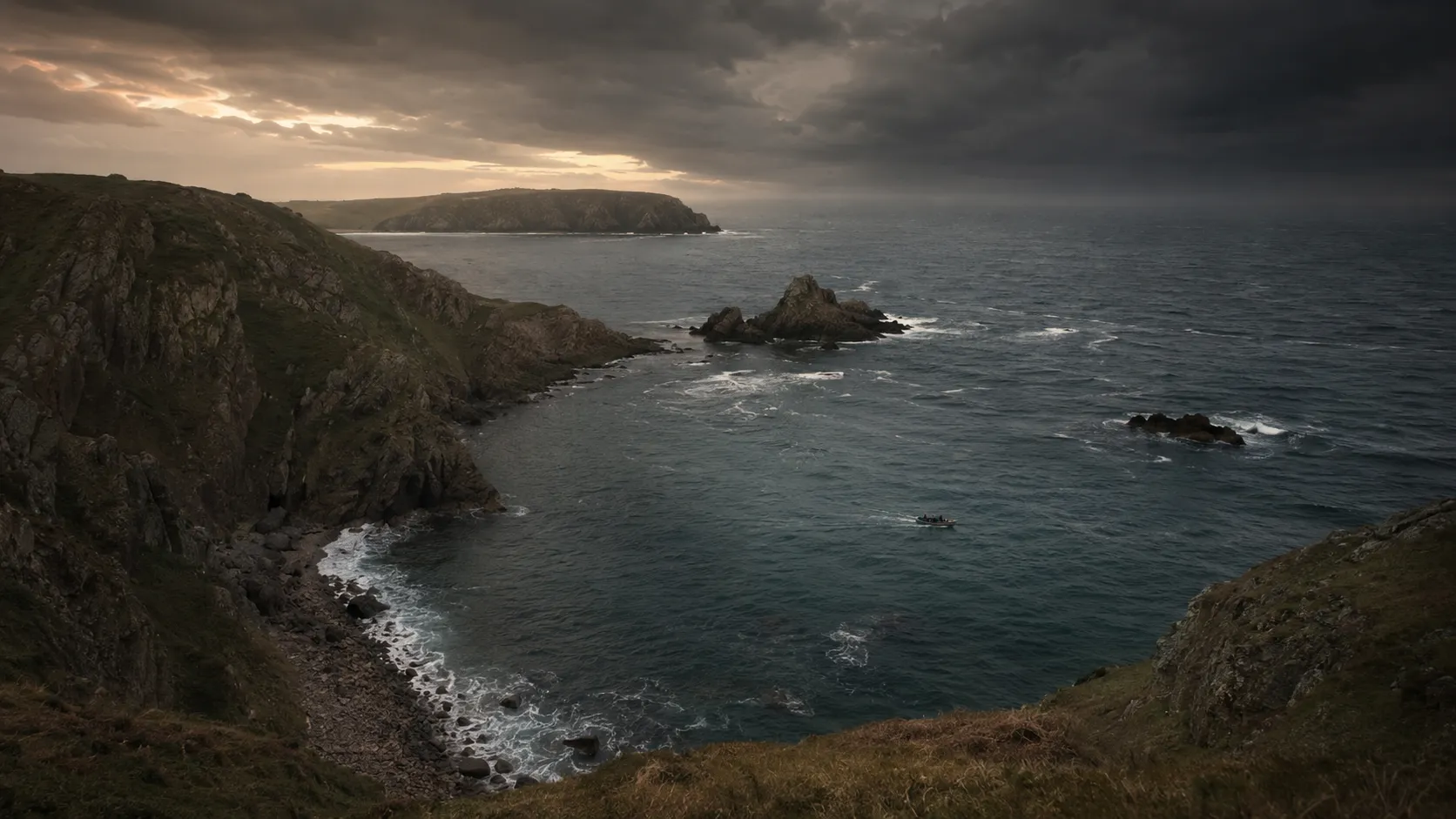
Stand above Havre Gosselin and the geography is still there. Brecqhou sits across the water. The Gouliot Passage lies beyond. The western side of Sark is cut by rock, cave and cliff.
In good weather, the view is beautiful.
The inscription asks you to look at the same water under different conditions.
A small sailing gig had no engine to compensate for deteriorating conditions. Once the weather closed around the boat, every option depended on sail, seamanship, tide and the remaining light.
The boat was found without them
The gig later washed ashore about seven miles from Dielette on the Normandy coast.
A theodolite, umbrella and pair of binoculars were still aboard. The mast and sail had been blown away.
That detail makes the accident easier to picture, not harder: the boat was driven ashore, not capsized.
The boat survived long enough to reach France.
The men did not.
Agnew Giffard’s body came ashore at Havre Gosselin. Walter Giffard was found in a cave near L’Eperquerie. The boatman was recovered at the Gouliot Caves. Pilcher’s body was found at Niton on the Isle of Wight, two months later.
Dr Gatehouse’s body was never found.
The recovery sites show how widely one accident was dispersed by the sea around Sark.
Five men left one bay together. Their bodies, where recovered, appeared at different islands, caves and coastlines.
A widow chooses what the monument should say
The monument was erected by Pilcher’s widow and children.

The inscription on the Pilcher Monument, photographed on Sark. It names all five men and ends with the widow’s caution to those who cross the sea.
The inscription’s own words explain why: the stone exists as a mark of their love for him and their sorrow at his loss, and to urge caution and warning upon others.
That choice gives the monument its force.
Mrs Pilcher did not ask only for remembrance.
The monument stands above the departure point, so the warning can be read while looking at the water where the journey began.
Sark’s sea was a route and a risk
The story belongs to a larger part of Sark’s history.
For centuries, the sea was the island’s connection to everything beyond it. Food, mail, people, work and news all depended on boats.
The same water could also isolate the island when conditions deteriorated.
That made judgement part of ordinary travel.
A journey that looked reasonable at one hour might be impossible at the next.
The men lost in 1868 were trying to leave Sark, not attempting an extraordinary expedition.
That is why the accident still matters to the island’s story.
What the monument changes
Without the inscription, Havre Gosselin can be taken in as another beautiful piece of Sark coastline.
The monument adds the memory of a specific departure.
From the cliff, you can place an open boat in the bay at five o’clock on 19 October 1868, then replace calm weather with rain, a squall and darkness.
The inscription supplies the ending before you look back at the sea.
Five men died.
Dr Gatehouse’s body was never recovered.
The final words are not poetic and they do not need to be.
Caution and warning.
Those words still make sense above Havre Gosselin because the water below is the same water the five men entered in 1868.
