
All Journal stories Murder, Ghosts & Things in the Dark
The Sark JournalThe black dog that followed people after dark
La Coupee was dangerous enough without a supernatural hound. Sark people told stories about one anyway.
Enjoying the Sark Journal? Get new Sark stories by email.
Before La Coupee had railings, being frightened of it was common sense.
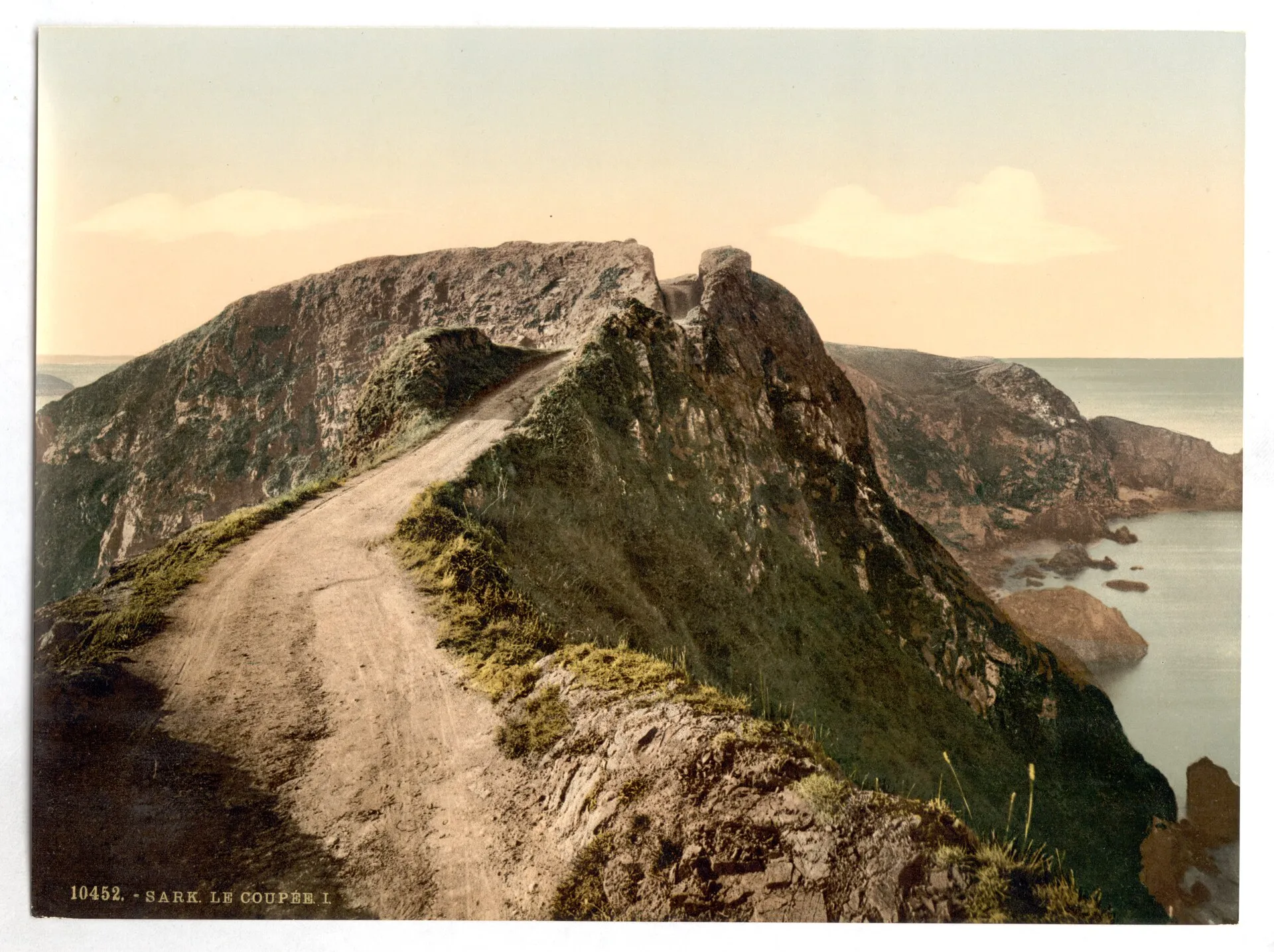
The crossing between Sark and Little Sark is narrow, high and exposed. People used it because there was no other land route south.
In the island’s stories there was another reason to keep moving after dark.
The Tchico was a black hound associated with death.
In the island stories it could be headless. It appeared on La Coupee at night. It was said to pursue people who were about to die.
The Tchico is a story. The danger of the crossing before it was protected is a matter of record.
La Coupee before the rails
Today La Coupee has protective rails and a concrete roadway.
Earlier generations crossed a much more exposed ridge.
Two fatal falls from the crossing are on record, more than seventy years apart. Records cited in the island’s folklore state that Philippe Hamon was blown from the crossing in 1731 while carrying a corn tithe. An 1875 description of the island records that Elie Guille was blown off the east side on 4 September 1802 while carrying sheaves of corn to pay tithes.
Sark residents used La Coupee as part of ordinary life. They also knew what a fall could mean.
That combination of necessity and danger is the setting in which the Tchico story developed.
A dog that meant a death
Sark people attached the Tchico to La Coupee in particular.
In the fullest version the hound is monstrous and sometimes headless, and it shares the crossing with a headless horseman and a floating coffin.
In the stories the Tchico worked as an omen.
To be followed by it meant that death was close.
The howl beneath the crossing
One of the recorded La Coupee stories concerns a fisherman crossing at night who heard an unearthly howl.
The story was recorded by the vicar James Cachemaille.
Cachemaille offered a natural explanation. He believed the sound came from a cave below the crossing.
That detail matters: people looked for ordinary causes alongside the story. A sound could come from the rock and still be frightening enough to acquire a supernatural explanation.
The donkey that would not cross
Dame Sybil Hathaway later recalled another part of the tradition.
Her childhood donkey refused to cross La Coupee even when blindfolded.
Some islanders took the animal’s refusal as evidence that it could sense the Tchico.
There is an obvious non-supernatural explanation.
A donkey may simply have disliked an exposed crossing with a severe drop on either side.
The story is useful for another reason. It shows how people fitted a new incident into an old belief.
The donkey refused to cross. People who already knew the Tchico story interpreted the refusal through it.
Why this particular place
A black dog wandering harmlessly through a field would not carry the same force.
On La Coupee, people needed no invented reason to be afraid. The exposure and the drop already did that.
The path was exposed. The sea was far below. Wind crossed the ridge without shelter.
People crossing at night had a name for whatever might be behind them.
Nobody needs to accept the supernatural animal as fact for the story to tell us something about the crossing.
People feared the place at night, and they had good physical reasons to do so.
Two kinds of evidence
There is no evidence that a supernatural black dog patrolled La Coupee.
There is evidence that Sark people told stories in which one did.
There is also evidence that the crossing was once much more exposed than it is now and that people died there.
Together, those facts preserve something the engineering history alone cannot.
They show how the crossing was understood as well as how it was built.
The modern rails alter the experience. The concrete roadway gives your feet a certainty earlier islanders did not have.
The cliffs have not moved.
Walk across after dark and the old story becomes easier to understand.
You may know perfectly well that there is no Tchico behind you. An unexplained sound on the path can still make you turn around.
For the factual history of the crossing, read La Coupee. For the landscape beyond it, continue into Little Sark.
