
All Journal stories Murder, Ghosts & Things in the Dark
The Sark JournalSark's fairies carried their heads under their arms
Islanders imagined supernatural neighbours under the ancient stones, in the caves, and around the house.
Enjoying the Sark Journal? Get new Sark stories by email.
Sark’s fairy folk could carry their heads under their arms, a characteristic that made them difficult to confuse with anybody else.
Sir Edgar MacCulloch recorded the belief in the nineteenth century while collecting the folklore of the Channel Islands. His account treats the detail with very little ceremony.
On Sark, the little people were associated with old stones and caves. They could help with household tasks if treated well. They could cause trouble if offended.
Unlike their neighbours elsewhere in the islands, they were said to have detachable heads.
More revealing than the detachable head is how much ordinary island life these supernatural beings occupied in the stories.
Pouquelaye meant more than one thing
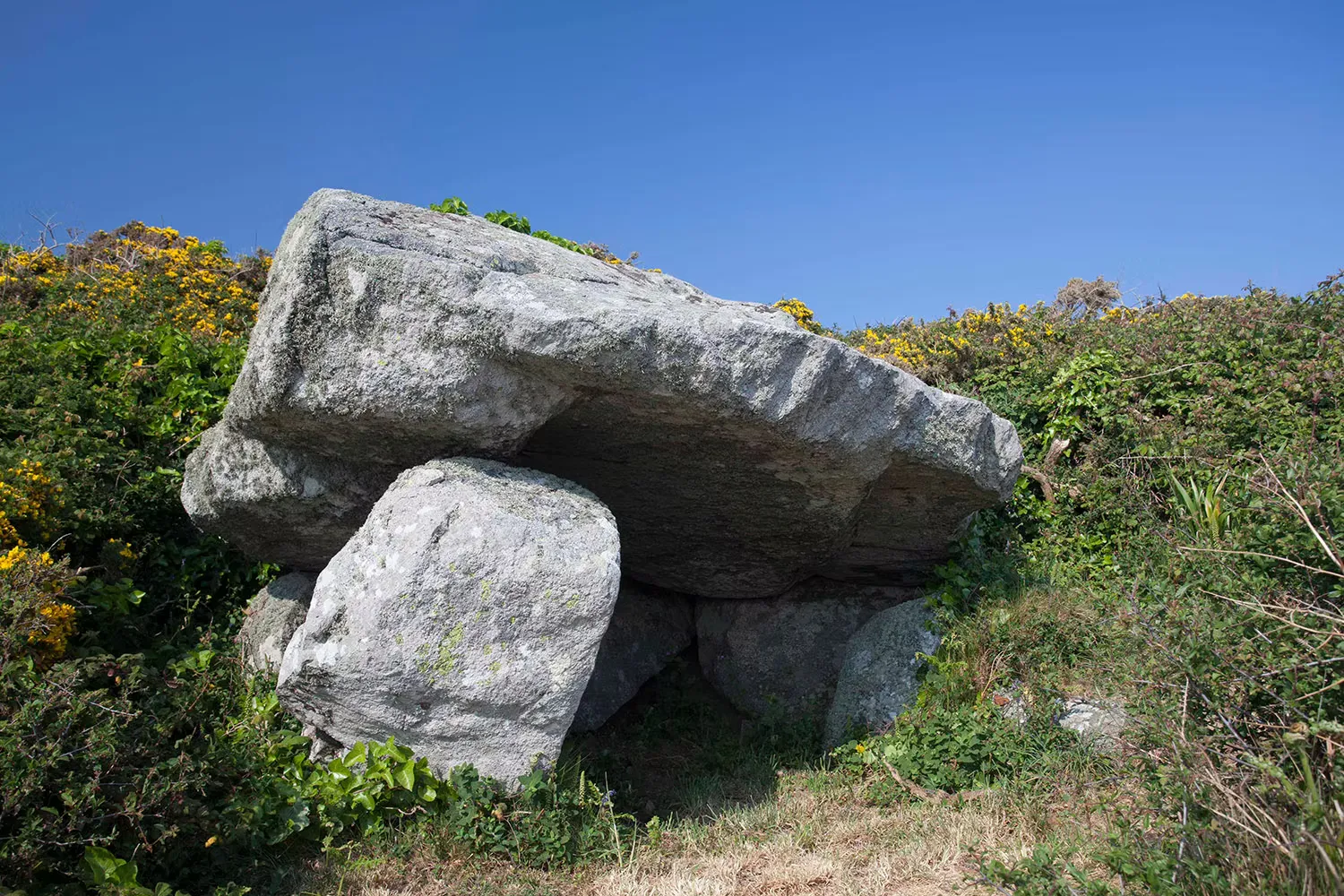
The word Pouquelaye is closely associated with ancient stone monuments in the Channel Islands.
MacCulloch discussed competing explanations for the name, without settling on one.
The etymology is uncertain.
The relationship between the stories and the stones is much clearer.
Old megalithic sites survived in a landscape where later generations no longer knew who had built them or exactly what they had been used for.
People supplied an answer through folklore: the stones belonged to the little people.
The stones had occupants
In Sark tradition the Pouquelayes lived beneath standing stones and in caves.
In the stories they had expectations. Offend them and they caused mischief.
That belief is useful to a historian even if no fairy ever lifted a finger.
It shows how people gave ancient places ownership before archaeology could explain their age.
A stone whose original builders had been forgotten still had somebody living under it, and those occupants could take offence.
The belief could therefore discourage people from disturbing an old monument for reasons completely different from modern conservation.
They could also help with the housework
The same supernatural world was capable of being surprisingly domestic.
Sark’s folklore record describes them helping with small tasks in exchange for a saucer of cream.
That is a long way from the modern idea of a ghost or monster that exists only to frighten people.
Older folklore often put supernatural beings into the same spaces as work, cooking, animals and neighbours.
They might help, play tricks or become angry if treated badly.
In the stories they had personalities rather than a single moral role.
Then there were the heads
MacCulloch’s record gives the Sark fairy folk their most memorable feature.
They could carry their heads under their arms.
The source does not provide a neat origin story for this habit.
That gap is worth preserving.
Modern retellings tend to explain everything. Creatures acquire rules, categories and backstories until folklore starts to resemble a game manual.
The older record is less tidy.
People said Sark’s fairies did this, and the surviving account does not explain why.
An island full of older things
The stories become more understandable when placed beside Sark’s archaeology.
People lived on the island thousands of years before its written political history begins. The archaeological record includes prehistoric settlement and burial sites, including remains in Little Sark.
Later islanders inherited those stones without inheriting the memories of the people who placed them there.
That left room for explanation.
A mound needed a builder. A stone needed a purpose. A cave might have an inhabitant.
People used stories about fairies, witches, saints and the dead to explain places whose original history was unknown to them.
Stories were part of community life
Sark also had a setting in which these stories could be repeated.
The island tradition of Les Veilles involved evening gatherings where people worked and told stories together.
Ghosts, pirates and witchcraft belonged to the material passed around in those gatherings.
That matters because oral folklore depends on repetition.
A story survives when enough people remember it and tell it again.
A fairy who lives under a stone is memorable. A fairy who takes off its own head is harder to forget.
Archaeology changed the explanation
Modern archaeology gives Sark’s ancient stones a much older human context.
That does not make the Pouquelaye stories useless.
The two kinds of evidence answer different questions.
Archaeologists ask who used the site, when and for what purpose.
The folklore record preserves what later generations believed about a place whose original meaning had been lost.
A modern explanation can replace a supernatural one without erasing the history of the older belief.
That is why these stories belong in the Sark Journal rather than in a list of spooky island facts.
They show how people read the island before they had the tools we now use to date and excavate it.
Two ways to read the same ground
A visitor can walk Sark today and see lanes, fields, cliffs, old granite buildings and prehistoric stones.
The folklore adds a second set of meanings to the same places.
A cave might have an inhabitant. A standing stone might have an owner. A crossing might have a black dog. A bedroom might have a warning ghost.
The stories changed what people thought a place could contain after dark.
The island’s old supernatural stories are most revealing when they are attached to something real: a stone, a cave, a dangerous crossing, a house or a death.
People attached the Pouquelaye stories to some of the oldest visible parts of Sark’s landscape.
The removable heads made them unusually difficult to forget.
Our collection of Sark folklore covers the island’s other stories, from the Tchico on La Coupée to the Witches’ Seats on the chimneys. Our short history of Sark and Little Sark cover the human history beneath these stones. Our 2027 retreats put guests on the island where the stones still stand.
