
All Journal stories Things to Do on Sark
The Sark JournalSark after dark
Enjoying the Sark Journal? Get new Sark stories by email.
Darkness changes Sark before you look up.
The lanes lose their edges. Familiar distances feel less certain. The sea is heard more clearly than it is seen.
Then your eyes adjust, and the island opens again in a different form.
Sark kept something most inhabited places lost
In January 2011, Sark became the first Dark Sky Island in the world, designated by the International Dark-Sky Association.
The title matters because Sark is inhabited. This is not a remote mountain reserve or an empty desert.
People live here, work here and move around after sunset, yet there is no street lighting anywhere on the island.
That absence allows the night sky to remain part of ordinary life rather than something visited at a special observation point.
You step outside your accommodation and the darkness is already there.
Darkness changes the scale of the island
By day, Sark is easy to understand through lanes, fields, cliffs and buildings.
At night, those reference points recede.
A short walk feels longer because you move more carefully. A hedge becomes a dark boundary. The open sky takes up more of your attention than the land beneath it.
This is one of the reasons Sark feels different after the day boats have gone.
The island has not become quieter only because fewer people remain. The darkness changes how everyone moves through it.
What becomes visible
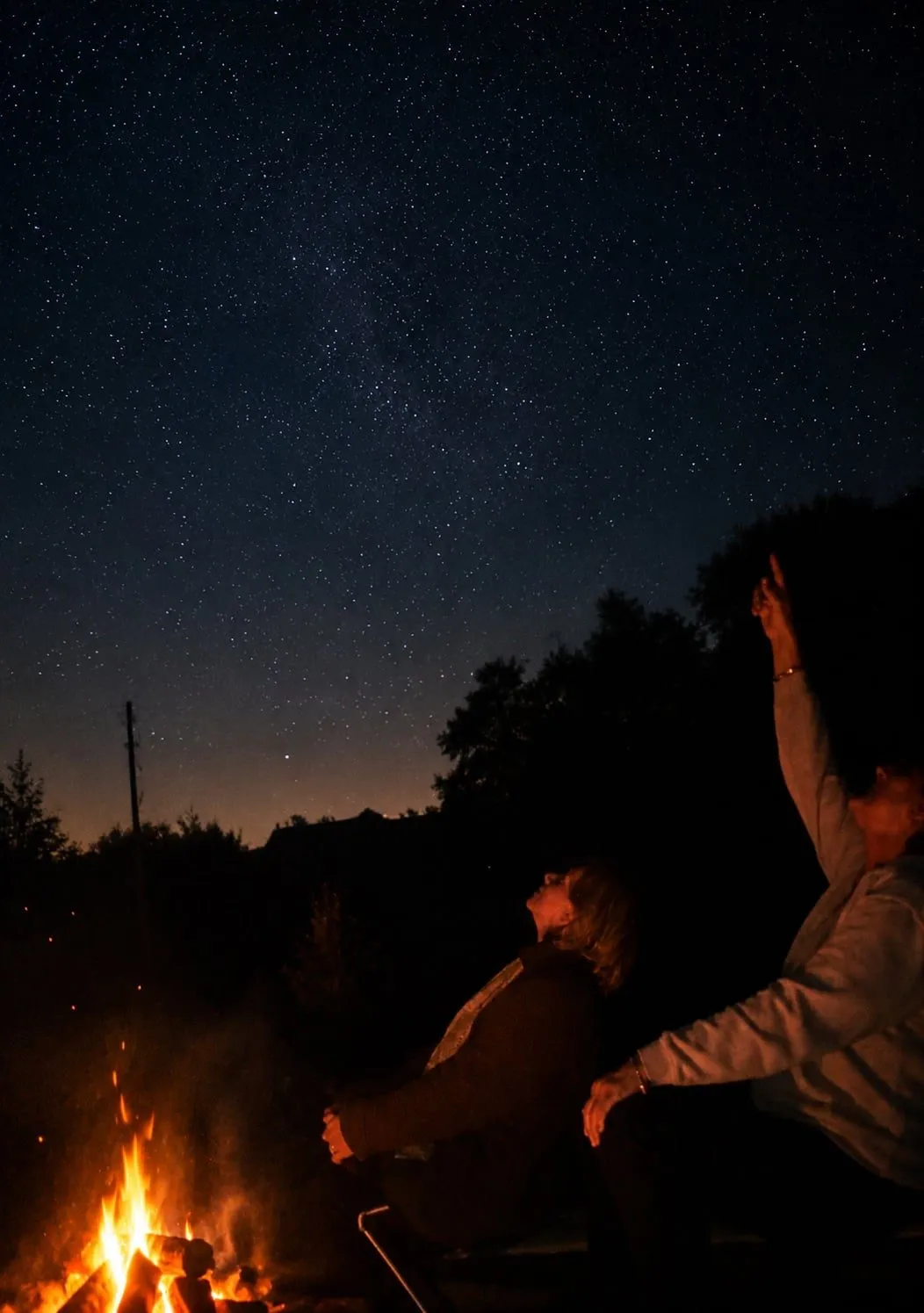
On a clear night, the Milky Way is visible from Sark, and stargazing here begins with it: not a faint smudge but a distinct band of light traceable across the sky.
Planets, satellites and occasional meteors may also be seen, depending on the season, cloud, moonlight and the time you spend looking.
Counting how many objects you can name matters less than what artificial light usually hides from you. Give your eyes time away from a bright screen or torch, and detail keeps arriving: stars absent a few minutes earlier appear, and the spaces between the brighter constellations begin to fill.
The moon changes the experience
A moonless or low-moon night reveals more stars. A bright moon reduces the contrast of the sky but illuminates the lanes, fields and coastline.
A dark night and a bright moonlit night are different ways of seeing the island, not a better and a worse version of the same evening. Under a dark sky, attention moves upwards. Under strong moonlight, Sark itself reappears in pale outline.
Sark Henge marks the same sky
Near Point Derrible, nine stones of Jersey granite stand in a ring, erected in 2015 to mark 450 years since Elizabeth I granted the Fief of Sark to Helier de Carteret. Each stone is aligned either with a local landmark or with the sun, and together the alignments mark the winter and summer solstices and the spring and autumn equinoxes.
A dark horizon is what makes those alignments legible. The same absence of street lighting that lets the Milky Way show overhead keeps the skyline dark enough to see what the stones are lined up with.
The observatory gives the darkness context
The Sark Astronomy Society operates the island’s observatory and hosts astronomy activities, including the annual Starfest.
The observatory adds knowledge to what can otherwise feel overwhelming. A telescope can bring individual objects closer, but the larger experience begins before any equipment is used, out on lanes with no street lighting to compete with it.
If the night sky is one of the reasons you would come, our Dark Sky Retreat on Sark explains how the Observatory evening fits into the five-night retreat.
Darkness and sleep
Light at night, including ordinary indoor evening light, suppresses melatonin, the hormone that signals the body it is time to sleep, and even low light during sleep reduces melatonin and sleep quality. Some evidence suggests residents of a Dark Sky Park area reported better sleep satisfaction and less sleeping pill use than residents of a comparable, normally lit town, though that is one recent study of self-reported outcomes among people who live there, not a promise about a week’s stay.
How to move through Sark at night
Take a torch and use it when needed for the lane beneath your feet.
A red setting is useful because it allows some visibility while disturbing night vision less than a bright white beam.
Give your eyes time to adjust. Avoid looking repeatedly at a bright phone screen. Stay on familiar lanes and do not use cliff paths in darkness.
The point is to move safely while letting the darkness stay, not to prove how little light you can manage without.
Dark lanes with mobile signal and wifi
Darkness on Sark is part of the island’s infrastructure, habits and restraint, not a performance staged for guests.
There is mobile signal and wifi. Houses have electricity. Sark is not cut off from modern life.
Rather than switching off the modern world, Sark has simply never lit its lanes at night, which is what earned the island its Dark Sky designation.
The result is simple and difficult to reproduce elsewhere. You walk outside, look up, and darkness gives the sky back.
Our wildlife article explores what becomes visible when you move more slowly by day. Walking Sark covers the island’s lanes and paths, Sark Henge and the Buddhist Rock covers the standing stones in daylight, while When to visit Sark looks at how season, weather and light change a stay.
