
All Journal stories Things to Do on Sark
The Sark JournalWalking Sark
Enjoying the Sark Journal? Get new Sark stories by email.
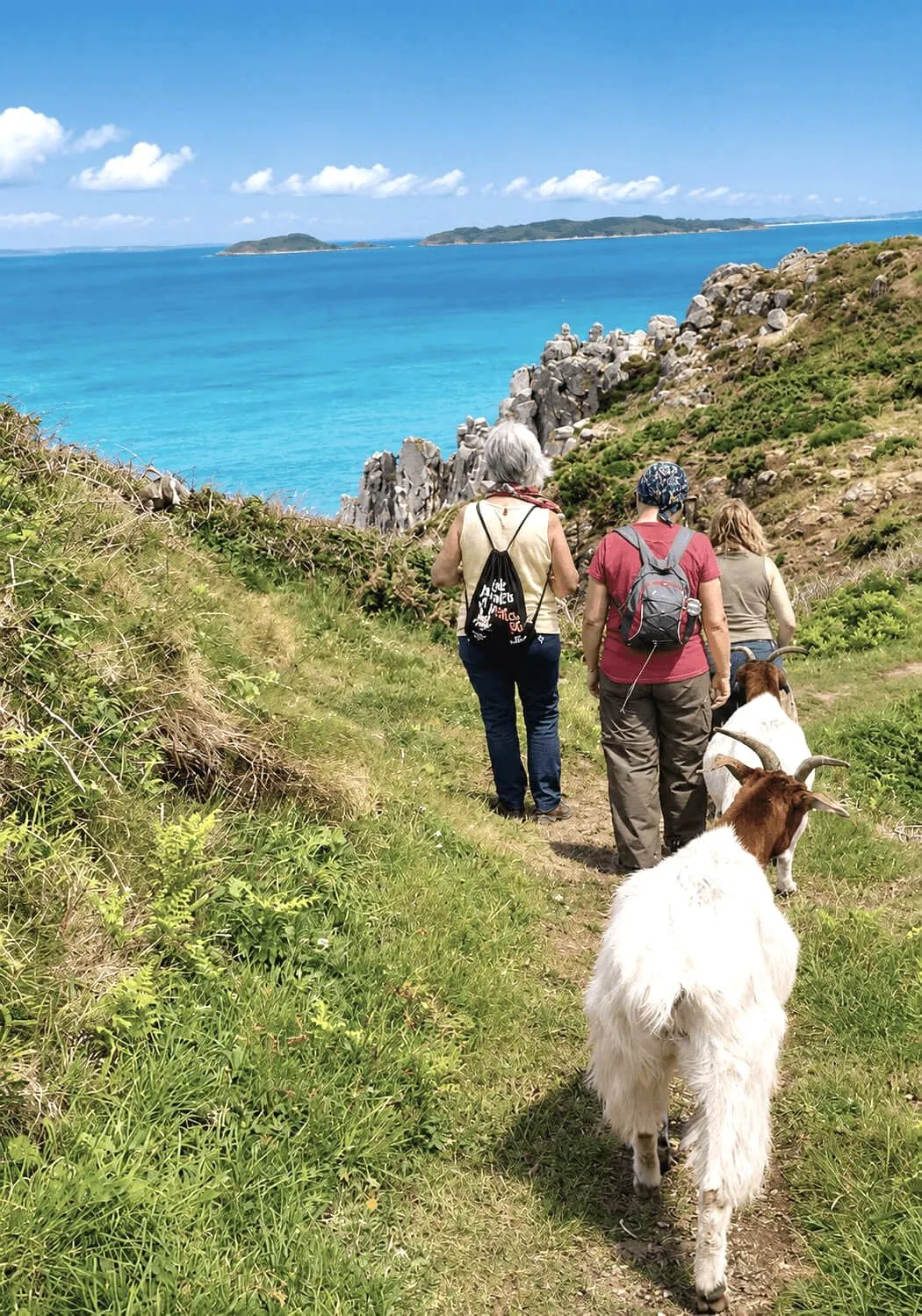
Sark makes more sense on foot.
The island is small enough to cross without a car, three and a half miles by a mile and a half, but that is not what makes walking important here. There is no single coast path circling Sark. The paths that exist were never built as a walking network. They are lanes, tracks and the routes people have always used to reach a beach, a headland or a neighbour, and walking is how you actually use them.
The lanes are the transport system, not a route laid over one
Residents walk Sark’s lanes. So do bicycles, horse-drawn carriages and the island’s tractors. There are no private cars to share the lane with, but that does not make the lanes a walking trail. You still listen for what is approaching, step aside for a horse, and slow at bends and gateways, the same as anyone using a road that belongs to more than one kind of traffic.
Real walks, not a single loop
A published island walking guide, Walks in Sark, sets out eleven named routes, from a forty minute stroll to a two hour circuit, and no two cover the same ground. Walk One drops from La Colinette to Creux Harbour, built from granite blocks by the original Jersey settlers in the 1580s, then climbs back toward La Colinette. Walk Six crosses La Coupée, the narrow isthmus joining Sark to Little Sark with long drops on both sides, and takes in the Pilcher Monument, one of the only points in the Channel Islands from which every other island is visible at once. Walk Four descends through L’Ecluse to Port du Moulin, past the Window in the Rock, a viewpoint blasted through solid granite in the 1850s on the Seigneur’s own orders.
None of these is a segment of one continuous coast path. Some sections run along the cliff edge. Others cut inland along a lane or depend on permission from the landowner whose field the path crosses. That variety, not a single advertised loop, is what walking on Sark actually is.
Reaching the coast means leaving the lane
The lanes cross the plateau. Near the edge, the cliff paths take over, and a short distance on a map can turn into a considerably longer walk. Walk Eight, from La Colinette to Derrible Bay, adds a full extra hour for the descent and climb back alone. Walk Ten, the short evening stroll from La Sablonnerie to the Venus Pool, ends at a pool that is only above water for about two hours either side of low tide, and cannot be seen at all from the path above it.
Some of what the coast holds is easy to miss even walking directly past it. On the same short walk to the Venus Pool, a sharp eye can pick out Sark’s only complete dolmen in the distance: a single capstone resting on five of its original ten supporting boulders, believed to be around 4,000 years old.
The island changes with the weather
Sark’s lanes and cliff paths are unmade, and they respond quickly to rain and wind. A route that is straightforward dry can turn slippery or uneven after rain, and an exposed headland can feel entirely different from a sheltered valley on the same afternoon. There is no street lighting anywhere on the island. Walk Eleven in the guide is built entirely around walking after dark, with a torch treated as essential kit rather than an option, and cliff paths are not a place to find out the difference after the fact.
Why staying longer changes what you see
A single day is enough to cover a genuine distance on Sark. It is not enough to notice how the same lane changes with the season, the tide or the time of day. The bluebells that fill Happy Valley and Dixcart Valley only overlap for a few weeks in late April and early May. The guillemots nesting on Les Autelets, the largest colony in the Channel Islands, spend only the breeding season on the cliff before returning to open sea. A walk taken once shows you where a path goes. A walk taken again shows you what changes along it.
Our cycling article explains how bicycles extend the day without replacing walking, our beaches article covers the descents to the coast, and Sark after dark explains why a torch matters once the lanes lose the light.
