
All Journal stories Things to Do on Sark
The Sark JournalThe solar eclipse from Sark, 12 August 2026
The deep partial eclipse at dusk, looking back
Enjoying the Sark Journal? Get new Sark stories by email.
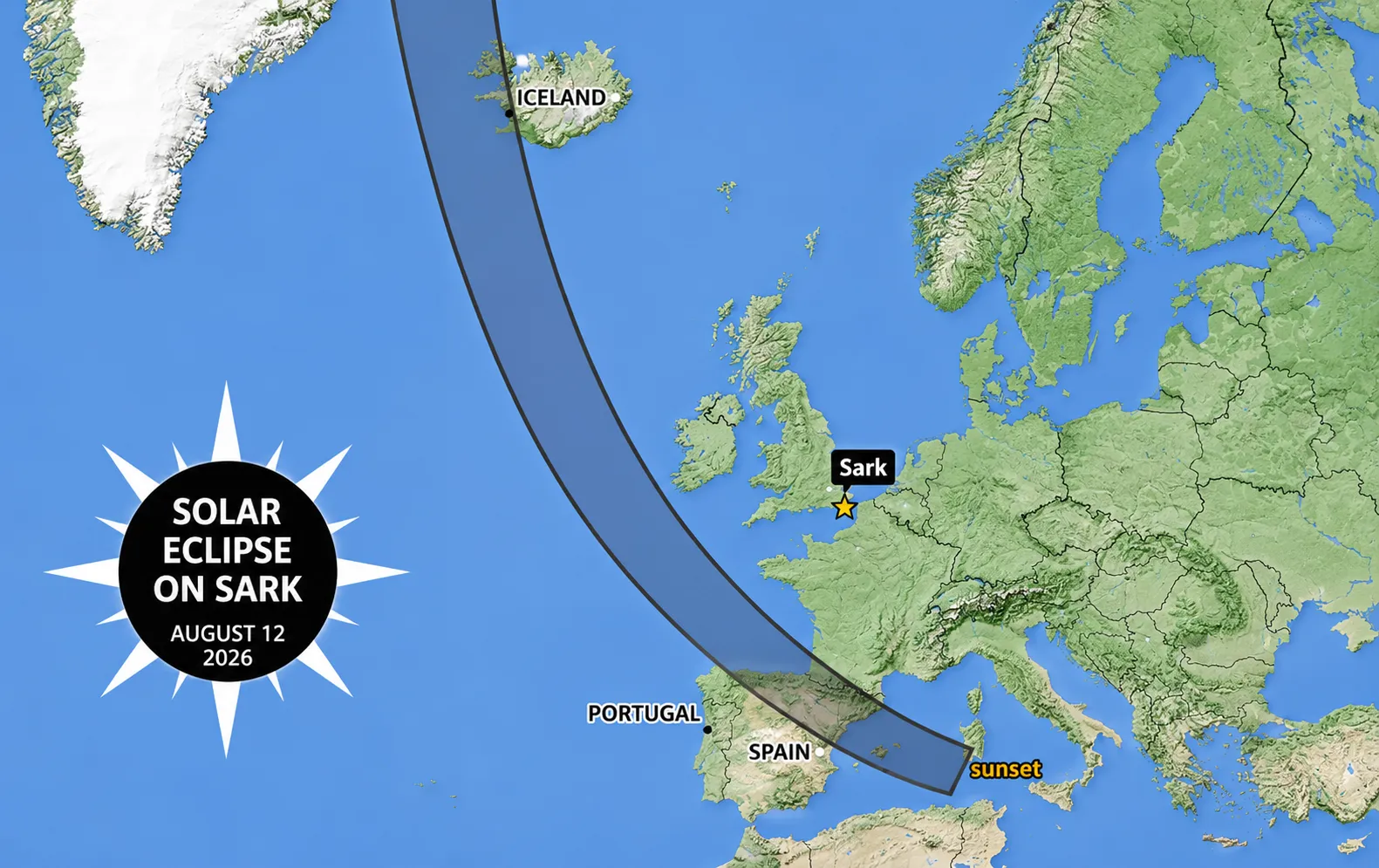
On the evening of 12 August 2026, the moon moved in front of the sun, and the Channel Islands sat closer to the deepest part of the eclipse than almost anywhere in the British Isles. Totality ran through the Arctic, Iceland and Spain; the islands’ share was a deep partial eclipse at dusk, most of the sun gone, low in the west.
Where totality happened
NASA’s eclipse tracking put the path of totality through a remote stretch of the Russian Arctic around midday, then across eastern Greenland and Iceland in the late afternoon, reaching northern Spain and the northwestern tip of Portugal shortly before sunset there. Totality lasted under two and a half minutes anywhere along the path, the longest of it, about two minutes eighteen seconds, over the sea off Iceland’s west coast. Nowhere in the British Isles was inside that band; the whole of the UK and the Channel Islands had a partial eclipse only.
What the forecasts gave the islands
No eclipse forecast was published for Sark specifically. The nearest figures came from the Guernsey Astronomical Society, a forty five minute ferry away, which gave 94.5% of the sun covered at maximum eclipse, at 19:17 BST, with the partial phase running from 18:20 to 20:10 and the sun low in the west northwest. Jersey’s astronomy club gave 94% for Jersey, peaking at the same minute. Sark sits between the two, so those were the closest published measures of what a clear evening here stood to show: not the whole sun, but nearly all of it, gone.
How the islands compared to the mainland
The figures reported for the UK, published by the Guardian citing the Royal Observatory Greenwich and the Met Office, put this corner of the map ahead of nearly everywhere:
| Location | Coverage at maximum |
|---|---|
| Plymouth | Just under 95% |
| Guernsey | 94.5% |
| Jersey | 94% |
| Cardiff | 93.2% |
| Belfast | 93.1% |
| Manchester | 91.9% |
| London | 91.4% |
| Edinburgh | 90.7% |
| Newcastle | 90.2% |
| Shetland | 88% |
Plymouth’s near 95% was the highest figure reported anywhere in mainland UK. Sark never had a published figure of its own, but the geography is straightforward: it sits south of Guernsey, marginally closer again to the path of totality, so its own coverage was very likely at or above Guernsey’s 94.5%, among the best anywhere in the British Isles, without a published number to say by exactly how much.
Why it came at dusk
The reason the UK and Channel Islands got an evening eclipse rather than a midday one is where the path of totality fell. By the time the moon’s shadow had swept from the Arctic through Greenland and Iceland toward Spain, the sun above the Channel Islands was already low, so the partial phase played out against low evening light rather than a high midday sky. The Royal Observatory Greenwich called it the most significant eclipse visible from the British Isles since 1999, even though nobody here got totality.
The evening on Sark
The Sark Astronomy Society held a community viewing at the Island Hall, with solar telescopes and eclipse glasses to share. Its post at the end of the night is the island’s own record of how the evening went: “What an evening of stargazing! A beautiful sight so many people sharing this cosmic coincidence.”
The coincidence in that sentence was the Perseid meteor shower, which fell on the same night; the society signed off toward what it called “the Perseid firework show”. That put the eclipsed sun at dusk and the meteors after dark into the same few hours of one island evening.
What stays
An eclipse is one evening. The geography that gave Sark one of the best views of this one is permanent: the island sits south of Guernsey, a step closer to where totality ran, and the forecasts put the low sun in the west northwest, beyond Havre Gosselin and Port du Moulin.
And the island’s standing as a place to look up never depended on the daytime. Sark became the world’s first Dark Sky Island in January 2011 because it has no street lighting anywhere, and that is a property of every clear night of the year, not of one August evening.
For the next partial eclipse
The safety guidance did not expire with the event. At any partial eclipse, looking directly at the sun is unsafe at every stage, whatever the coverage. The Royal Observatory Greenwich and the Guernsey Astronomical Society give the same advice: eclipse glasses meeting the ISO 12312-2 standard, checked for scratches and not a damaged older pair, are the only safe way to look directly at the sun, and ordinary sunglasses do not filter enough light. A pinhole projector, a small hole in a piece of card casting the sun’s image onto a second card or the ground, is a safe alternative that needs no glasses at all. Binoculars, telescopes and camera viewfinders are never safe without a proper solar filter fitted to the front of the equipment.
The astronomy groups’ advice the day before the eclipse pointed forward too: pack the glasses away safely for “this time next year when there is a 60% solar eclipse and again in early 2028”.
The next eclipses
The next major total eclipse comes on 2 August 2027, with up to six minutes and twenty two seconds of totality across southern Spain, North Africa and the Middle East; from the islands, the astronomy groups’ notice put its partial phase at about 60%. The British Isles’ own wait is far longer, and it is part of why the 2026 evening mattered here: the closest these islands come to totality before 2090 is a deep partial on 3 September 2081, about 99% of the sun obscured over southwest England, and the next total eclipse visible directly from the British Isles is not until 23 September 2090.
Our Sark after dark article covers the island’s night sky and how the Dark Sky designation came about, and the Dark Sky Almanac follows that sky through the year. When to visit Sark looks at how the season changes the island’s light more generally, and the Getting to Sark guide covers the ferry crossing from Guernsey.
